The New Luxury Villa Buyer in Bangalore: Who Is Buying, Why, and What They're Looking For in 2026
Walk through a sales lounge in Bangalore’s luxury villa market today and the room looks nothing like it did five years ago. Fewer grey-haired retirees weighing a retirement home. Fewer investors flipping through brochures with a calculator open on their phone. In their place: founders in their late thirties, senior executives comparing notes with their spouse, and a growing number of women leading the conversation rather than accompanying it. The luxury villa buyer in Bangalore has changed.
Understanding why this shift has happened matters as much as observing it. Bangalore’s technology and startup economy has now been generating serious personal wealth for close to two decades, long enough for a substantial cohort of professionals to move from earning well to having genuinely significant, liquid net worth through IPOs, acquisitions and secondary share sales. Unlike inherited wealth, this money tends to arrive with a clear-eyed, almost analytical approach to spending it, and a luxury villa buyer in Bangalore of this profile scrutinises a purchase with the same rigour they would apply to a term sheet.
From Investor to End User
The single biggest structural change in this market is the declining share of pure investors. A decade ago, a meaningful proportion of luxury villa transactions in Bangalore were driven by buyers who had no intention of living in the property, treating it purely as a store of value in a market with limited alternatives. That calculus has shifted on two fronts at once. Equity markets, structured investment products and a wider set of asset classes now compete for the same investor capital, pulling speculative money away from villas. At the same time, rising personal wealth among Bangalore’s professional class means more buyers now have the liquidity to purchase a villa simply to live in, independent of its investment case, so villas increasingly attract buyers who want to actually live in, or regularly use, what they are purchasing.
This matters enormously for the kind of product that succeeds. An investor-led market rewards developers who can move volume, favouring larger unit counts and faster construction timelines. An end user luxury villas in Bangalore market rewards developers who get the details right: layout logic, material quality, community management, and whether the finished home actually feels like somewhere a discerning family wants to spend their evenings. It also changes long-term community quality, since end users tend to invest in their surroundings, participate in community decisions and stay for years rather than exiting at the first attractive offer.
A Younger, More Operational Buyer
The age profile has moved meaningfully younger. Where the archetypal luxury villa buyer in Bangalore once sat in the 55-plus retiree bracket, purchasing decisions in 2026 are increasingly made by professionals in the 35 to 50 age range: founders who have exited a company or raised a significant round, senior executives at global technology firms, and partners at consulting or private equity firms. This cohort brings a different set of expectations to the table. They are less patient with vague delivery timelines. They evaluate a project on documentation and RERA compliance rather than relationship alone. And they are considerably more demanding about the practical, day-to-day functionality of the home: reliable connectivity, well-designed home offices, and infrastructure that supports a life still very much anchored in work.
For this buyer, the villa is not a reward for having finished working. It is infrastructure for continuing to work well, alongside living well, which is a materially different design brief than the retirement-oriented luxury home of a decade ago. Where a retirement-oriented villa once prioritised leisure amenities and low-maintenance living, this buyer instead prioritises bandwidth, quiet workspaces and infrastructure that supports a full working week from home. Family structure factors into this too. A large share of this cohort has school-age children, which means proximity to reputable international schools, safe cycling or walking distance within the community, and a genuine sense that the neighbourhood is being built for young families rather than retrofitted for them, all weigh heavily in the final decision.
Women as Primary Decision-Makers
One of the more consequential and less discussed shifts in this market is the growing share of women as primary or joint decision-makers in luxury real estate purchases. This is not a token presence in the conversation. Sales teams across Bangalore’s premium developments increasingly report women driving the shortlisting process, leading site visits, and asking the most detailed questions about layout flow, natural light, kitchen design and landscaping. The implication for developers is straightforward: a project designed primarily to impress on paper, through amenity lists and marketing renders, performs worse with this buyer than a project that holds up to a genuinely detailed, lived-in evaluation of how the home actually functions across a full day.
This shows up in concrete ways during site visits. Questions about where the laundry and utility areas sit relative to the bedrooms, how much afternoon sun a particular garden-facing room receives, or whether the kitchen layout supports a household that entertains frequently are now standard rather than exceptional. Developers who can only answer these questions with a floor plan, rather than a walkthrough of the actual reasoning behind the layout, tend to lose this buyer’s confidence quickly.
NRIs Re-Entering the Market, Differently
Non-resident Indian buyers, a segment that pulled back somewhat during a period of pandemic-era uncertainty and currency volatility that continues to this day, are re-entering Bangalore’s luxury villa market with a different set of priorities than before, a shift explored in more detail in our review of NRI real estate investment trends in Bangalore for 2026. Where earlier NRI purchases were often speculative, bought sight unseen based on a broker’s recommendation, the current wave is considerably more deliberate. These buyers are prioritising managed, professionally run communities over standalone plots, developers with demonstrable delivery track records over attractive launch pricing, and locations with clear infrastructure momentum, such as proximity to Bangalore’s international airport, over purely central addresses that are harder to monitor from abroad.
This is a buyer who wants the asset to essentially manage itself between visits, which places a premium on developers who offer genuine facilities management rather than simply handing over keys and stepping away, a priority we explored previously while examining premium villas as an NRI investment category.
For NRIs specifically, this shift also reflects a broader evolution in NRI investment in Bangalore real estate, where tax clarity and remotely manageable assets increasingly outweigh purely speculative upside.
What This Evolved Buyer Actually Wants
Verifiable credibility: RERA compliance, construction progress that can be independently checked, and a developer with a track record of delivered projects
Functional luxury: homes engineered for connectivity, home offices and daily usability, not just show-flat aesthetics
Community scale that stays intentional: low-density masterplans over sprawling, high-unit-count developments
Design depth that rewards close inspection: layout logic, material choice and landscaping that hold up under detailed scrutiny, not just first impressions
Professional, ongoing community management, particularly important for NRI buyers and dual-career households with limited bandwidth
Mapping This Buyer to Amanvana’s Product DNA
It is worth examining how closely this evolved buyer profile maps onto the current generation of North Bangalore villa communities, and Amanvana Bangalore is a useful case in point. Its boutique scale of 95 four-bedroom villas across 14 acres speaks directly to a buyer who values genuine low density over sheer unit count, and its amenity depth, spanning a clubhouse, yoga deck and resort-grade landscaping, is built for daily use by an end-user household rather than for a one-time impression on an investor.
Its position among the luxury villas on IVC Road, minutes from Kempegowda International Airport, addresses precisely the infrastructure priority that has become central to how both younger domestic buyers and re-engaged NRI buyers are evaluating a location today.
This alignment is not incidental. It reflects a broader pattern across White Lotus Group’s portfolio: projects conceived around how a discerning household actually lives, evaluated by who is genuinely buying luxury villas in North Bangalore right now rather than by who bought them a decade ago.
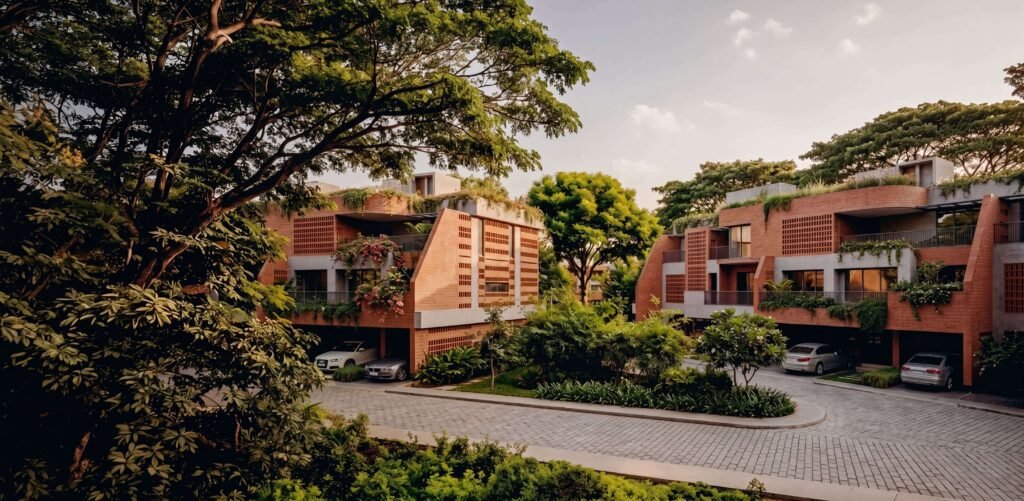
Source: White Lotus Amanvana
Why This Matters Through 2030
Buyer profiles rarely shift back once they have moved this far. The end-user-led, younger, more operationally minded and increasingly female-influenced buyer emerging in Bangalore’s luxury villa market in 2026 is likely to remain the dominant customer through the rest of the decade, particularly as more of the city’s technology and consulting wealth matures into a stage where a second or upgraded home becomes a natural decision rather than an aspirational one. For developers, this is less a passing trend to accommodate than a permanent recalibration of who the product needs to be built for.
There is also a compounding effect worth noting. As this buyer cohort settles into communities that genuinely suit them, word of mouth within tightly networked professional circles, technology leadership groups, founder communities and alumni networks, tends to do more to shape a project’s reputation than any advertising campaign could. A community that earns quiet, specific praise from a resident’s own peer group is difficult for a competitor to replicate, which is precisely why getting the product right for this buyer the first time carries outsized long-term value for a developer.
The projects that will command a premium through 2030 are unlikely to be the ones with the longest amenity list. They will be the ones that pass the scrutiny of a buyer who reads RERA filings before scheduling a site visit, brings their spouse to every meeting as an equal decision-maker, and expects the home to function as well on a Tuesday afternoon as it photographs on a marketing brochure. Communities such as Amanvana Bangalore are, in effect, a working answer to that expectation, built at a scale and with a design philosophy calibrated to exactly this buyer.
Frequently Asked Questions
1. Who is actually buying luxury villas in Bangalore in 2026?
The dominant buyer today is an end user rather than an investor: professionals aged 35 to 50, including founders, senior executives and consulting or private equity partners, purchasing to live in the home rather than flip it. Women are increasingly primary or joint decision-makers, and NRIs are re-entering with more deliberate, less speculative priorities.
2. Why are luxury villas in North Bangalore attracting younger buyers now?
Bangalore’s technology and startup economy has matured enough to create a large cohort with significant liquid wealth in their late thirties and forties. This buyer wants a home that functions as infrastructure for continuing to work and live well, prioritising connectivity, home offices and family-friendly surroundings over the leisure-first amenities that suited an older, retirement-oriented buyer.
3. What do the best luxury villas in Bangalore need to offer this new buyer profile?
Verifiable credibility (RERA compliance, checkable construction progress), functional luxury built for daily use rather than show-flat aesthetics, intentional low-density community scale, design that holds up under close inspection, and professional ongoing community management, particularly valued by NRI buyers and dual-career households.
4. Why are more women leading the decision-making process for a 4 bedroom villa in Bangalore?
Sales teams increasingly report women driving shortlisting, leading site visits, and asking detailed questions about layout flow, natural light and kitchen design. This buyer evaluates a home on genuine day-to-day functionality rather than marketing renders, which is reshaping how developers need to present and design their projects.
5. How is Amanvana Bangalore positioned for this evolved buyer profile?
As a White Lotus Amanvana community of 95 four-bedroom villas across 14 acres, its boutique scale, amenity depth and proximity to Kempegowda International Airport align directly with what this buyer prioritises: low density, daily usability, and infrastructure-driven location choices, particularly relevant for younger domestic buyers and re-engaged NRIs alike.
6. Are NRIs still buying White Lotus villas in North Bangalore, and has their approach changed?
Yes, NRIs are re-entering the market, but more deliberately than before. Today’s NRI buyer prioritises managed, professionally run communities over standalone plots, developers with proven delivery records over launch pricing, and infrastructure-forward locations, reflecting a shift toward assets that can essentially manage themselves between visits.