The Golden Corridor: Why IVC Road Is the Epicenter of North Bangalore's Luxury Boom
Introduction
In the long story of Bangalore’s real estate cycles, the corridors that become significant tend to announce themselves quietly before the broader market recognises what is happening. Whitefield was a software-adjacent outpost long before it became the city’s most densely developed IT suburb. Sarjapur Road was a peripheral route connecting the eastern edge of the city before it became synonymous with a certain kind of mid-market ambition.
IVC Road, in 2026, is at that inflection point. For buyers exploring villas for sale in Bangalore, it is not yet the first name that comes to mind but it is building, with growing pace, a set of fundamentals that are genuinely difficult to replicate anywhere else in the metropolitan area.
This article is a serious attempt to explain why. Not through marketing language or speculative projections, but through a careful reading of the infrastructure, economic, regulatory, and geographic factors that are converging on this specific stretch of North Bangalore luxury property.
Chapters
- Introduction: The Golden Corridor
- The Geography of IVC Road: Situating the Corridor
- The Infrastructure Stack: What Is Being Built
- Kempegowda International Airport and Its Influence
- The Blue Line Metro Extension
- The BIAL IT Investment Region
- The Aerospace Park and Defence Corridor
- Social Infrastructure: Education, Healthcare, and Retail
- The Devanahalli Micro-Market: A Closer Look
- How IVC Road Compares to Other North Bangalore Micro-Markets
- The Investment Case: Why the Fundamentals Are Strong
- White Lotus Amanvana: A Specific Reference Point
- Looking Ahead: Devanahalli Real Estate Growth 2026 and Beyond
- A Practical Guide for Buyers Evaluating the Corridor
- Conclusion: The Corridor That Earns Its Premium
The Geography of IVC Road: Situating the Corridor
IVC Road, formally known as Inter Village Connectivity Road, runs through the Devanahalli taluk in Bangalore Rural District, connecting the areas around Kempegowda International Airport to the broader North Bangalore urban fabric. It sits within the Bangalore Metropolitan Region Development Authority’s (BMRDA) planning jurisdiction, which has designated significant portions of the surrounding area for planned development under the revised Master Plan.
The road’s orientation places it at the intersection of several major infrastructure vectors: within 20 kilometres of the airport, in proximity to the proposed Aerospace Park and Devanahalli Business Park, and within the catchment area of the Blue Line Metro extension. Geographically, the corridor retains significant natural assets – rolling terrain, a high density of water bodies, and a visual environment that is still substantially green and open. This is precisely what separates luxury villas near Bangalore airport in this corridor from the more congested alternatives elsewhere in the city.
The Infrastructure Stack: What Is Being Built
Kempegowda International Airport and Its Expanding Influence
The most significant single piece of infrastructure shaping the IVC Road villas Bangalore market is Kempegowda International Airport. The proximity to the airport matters for luxury real estate in ways that are not always obvious. For the NRI buyer profile article segment, predominantly HNIs, senior professionals, and NRIs, frequent air travel is a given. The ability to reach the airport in 20 to 30 minutes, without navigating arterial congestion, is a genuine quality-of-life advantage.
Beyond convenience, proximity to a major international airport fundamentally changes the profile of a residential market. Locations around global aviation hubs tend to attract a more mobile and affluent buyer base, including business leaders, entrepreneurs, and internationally connected professionals. This creates sustained demand for premium housing and supports long-term value appreciation. As Kempegowda International Airport continues to expand its passenger and cargo capacity, the surrounding Devanahalli corridor is increasingly being viewed not as a peripheral location, but as a strategic residential destination linked to one of South India’s most important economic gateways.
The airport is also an economic generator in its own right. The businesses, hotels, logistics facilities, and ancillary services that cluster around major international airports create employment and economic activity that sustains demand for surrounding real estate. This effect is well-documented in global aviation markets and is beginning to manifest clearly around Devanahalli.
The Blue Line Metro Extension
Bangalore’s metro network expansion has been one of the most consequential developments for real estate values across the city, and the Blue Line extension to Kempegowda International Airport represents the single most transformative connectivity improvement in North Bangalore’s history.
The Blue Line, once fully operational on its extended route, will connect the airport and the surrounding Devanahalli corridor to the core of Bangalore’s metro network within a journey time that makes daily commuting practical for a much wider range of residents than the current road-dependent connectivity allows. This has a direct and well-established impact on residential property values: research consistently shows that proximity to metro stations increases residential values by 10 to 25 percent over medium-term horizons, with the largest gains accruing to locations that transition from poor to good public transit connectivity.
For the IVC Road corridor, the Blue Line extension is not merely a convenience improvement. It is a structural upgrade to the location’s accessibility profile that will attract a new generation of buyers and residents who had previously considered North Bangalore too peripheral for practical consideration.
The BIAL IT Investment Region
The BIAL IT Investment Region – a notified special investment zone covering approximately 12,000 acres around the airport is one of the most significant economic development interventions in Bangalore’s recent history. When a professional can live in Devanahalli, work in the BIAL ITIR, commute to the airport for travel, and access the city centre by metro for occasional visits, the calculus of location choice changes fundamentally. North Bangalore stops being a peripheral location and becomes a complete urban environment in its own right, which is exactly the story that the best luxury villas near Bangalore airport are already telling.
The Aerospace Park and Defence Corridor
Adjacent to the airport, the Aerospace Park established under the Karnataka government’s industrial policy is host to a cluster of aerospace manufacturing, maintenance, and technology companies. This includes suppliers to major aircraft manufacturers, defence component manufacturers, and aviation services businesses that collectively represent a significant and specialised employment base.
The Aerospace Park creates demand for a specific type of professional housing: senior engineers, research professionals, and executives at aerospace companies tend to have similar housing profiles to their counterparts in the technology sector. They earn well, they value quality of living, and they are often internationally mobile, giving them exposure to residential standards in Germany, France, the United States, or Singapore that shape their expectations of what a home should be.
This professional base is a natural constituency for the kind of luxury villa community that the IVC Road corridor is beginning to develop. Their proximity to the airport and the ITIR makes the Devanahalli micro-market practically convenient as well as residentially appealing.
Social Infrastructure: Education, Healthcare, and Retail
The historical knock against peripheral Bangalore locations, including the areas around Devanahalli, was not connectivity but social infrastructure. The absence of good schools, quality hospitals, and the retail and hospitality infrastructure that urban professionals consider standard has been the primary reason that many buyers, even those positively inclined to the location, have hesitated.
This gap is closing, more rapidly than most market observers had projected. Several significant educational institutions have established campuses in and around Devanahalli in recent years. Hospital groups with established brands in urban Bangalore are developing facilities in North Bangalore as population growth demands it. Retail and hospitality projects are following the residential demand curve.
The progress is not uniform. There are still gaps in the social infrastructure of North Bangalore that buyers should be aware of and evaluate against their specific household needs. But the trajectory is clear, and the pace of improvement has accelerated significantly over the past three to four years. The Devanahalli of 2026 is a meaningfully better-serviced location than it was in 2020, and the Devanahalli of 2030 will be better serviced still.
The Devanahalli Micro-Market: A Closer Look
Within the broader North Bangalore corridor, Devanahalli taluk has emerged as the most significant concentration of luxury residential development. This is a function of several overlapping factors.
First, Devanahalli has the land. The taluk contains substantial parcels of developable land in locations that combine good accessibility with the natural environment quality that luxury residential buyers value. This land is increasingly scarce in the established micro-markets of urban Bangalore, which is why developers targeting the luxury segment are positioning in Devanahalli now, while site selection remains viable.
Second, Devanahalli has a planning framework that has been calibrated, more thoughtfully than some peripheral Bangalore locations, to guide development in ways that preserve amenity value rather than simply maximising built density. The BMRDA’s planning documents identify North Bangalore, and Devanahalli specifically, as a priority zone for quality residential development, with provisions for green buffers and density controls that give developers confidence that the residential environment they create will not be overwhelmed by incompatible adjacent development over a ten-year horizon.
Third, Devanahalli benefits from the historical and cultural associations of the area. It is the birthplace of Tipu Sultan, an association that gives the taluk a certain historical texture that has no equivalent in the newer development corridors of Bangalore. The existing town, the Venkatala Fort, the traditional agricultural landscapes, all of these contribute to a sense of place that pure new-development zones cannot replicate.
How IVC Road Compares to Other North Bangalore Micro-Markets
IVC Road vs. Hebbal
Hebbal is North Bangalore’s most established premium location, the gateway to the city’s northern ring road and home to several of Bangalore’s best-known IT campuses. It commands strong residential prices and has a well-developed social infrastructure. But Hebbal is also close to saturation as a residential location. Land prices are high, available parcels are limited, and the density of the existing urban fabric means that the spatial quality of new development is inevitably constrained. The IVC Road corridor offers land availability and natural environment quality that Hebbal simply cannot match.
IVC Road vs. Yelahanka
Yelahanka is one of North Bangalore’s oldest residential areas. Its limitation is that it is, essentially, a mature urban location rather than an emerging premium corridor. The characteristics that make IVC Road particularly compelling for villa projects in North Bangalore – the density of water bodies, the visual openness, the proximity to the BIAL economic zone are much less pronounced in Yelahanka.
IVC Road vs. Devanahalli Town
Devanahalli town itself is the administrative centre of the taluk and has its own residential market, primarily serving the existing population base. It lacks the site selection quality of the IVC Road corridor, and development there tends to serve a more price-sensitive buyer profile than the luxury villa market. IVC Road offers the geographic advantages of the Devanahalli location without the urban density and infrastructure constraints of the town centre.
IVC Road vs. Nandi Hills Road Corridor
The Nandi Hills Road corridor is perhaps IVC Road’s most direct competitor for the luxury villa buyer. It offers genuine natural beauty, excellent air quality, and a landscape that is among the most visually compelling in the greater Bangalore region. Its limitation is distance: it sits further from the airport, the ITIR, and the metro extension than the IVC Road corridor, which reduces its practical appeal for buyers whose lives require regular engagement with the city’s commercial and transport infrastructure. For a purely retreat-style second home, the Nandi Hills corridor is compelling. For a primary residence that must also function as a practical base for a professionally active life, IVC Road offers a better balance.
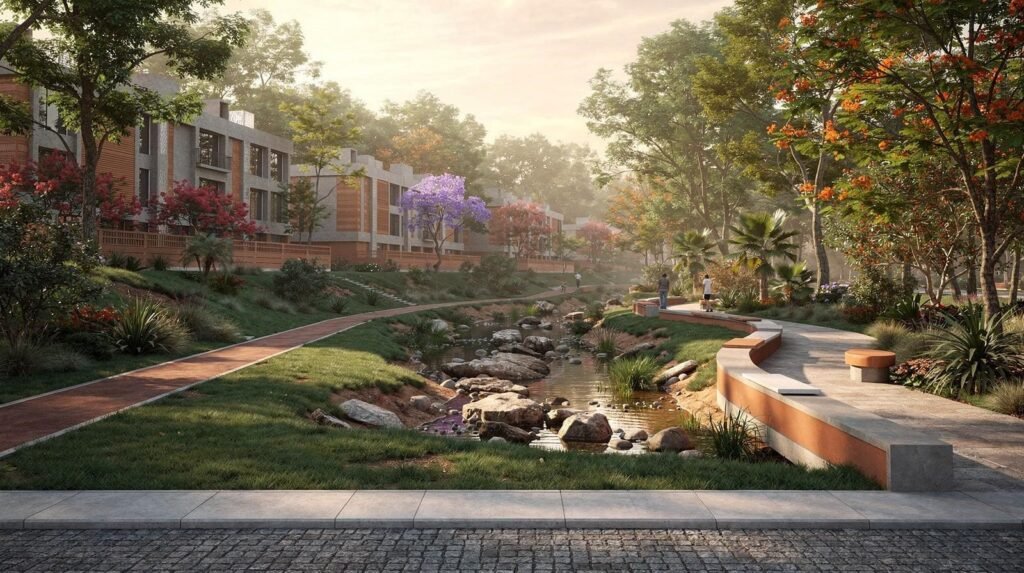
When looking at property on IVC Road, it is clear that while Hebbal and Yelahanka are mature, they lack the spatial quality of the emerging North. For a primary residence that must also function as a practical base for a professionally active life, IVC Road offers a better balance than even the Nandi Hills corridor.
Source: White Lotus Amanvana
The Investment Case: Why the Fundamentals Are Strong
The case for luxury villas in Bangalore North corridor rests on fundamentals that are more durable than the speculative narratives driving interest in other parts of the city. The airport is permanent and growing. The ITIR is real and progressing. The metro connection is transformational. And supply discipline in the luxury segment the – land requirements for genuine low-density development, the planning controls on density in the BMRDA area and all act to limit the volume of product that can enter the market.
The airport is permanent and growing. Airports do not relocate. Kempegowda International Airport will be the dominant aviation hub for South India for the foreseeable future, and its expansion programme confirms the long-term commitment of national infrastructure investment to this location. Proximity to a major international airport is one of the most stable and reliable premium drivers in urban real estate globally.
The ITIR is real and progressing. Investment zones of this kind take time to develop, but the BIAL ITIR has moved beyond the planning stage into active development. The combination of government commitment, private investment, and institutional infrastructure means that the employment base it is building will generate sustained residential demand in the surrounding area.
The metro connection is transformational. The Blue Line extension will permanently alter the connectivity profile of the Devanahalli corridor. Properties that benefit from this connectivity improvement will accrue the associated premium, and those who purchase before the premium is fully priced in are positioned to capture the appreciation differential.
Supply discipline in the luxury segment. The luxury villa segment in the IVC Road corridor is, by design, supply-constrained. The land requirements for genuine low-density development, the planning controls on density in the BMRDA area, and the economics of premium villa construction all act to limit the volume of product that can enter the market. In the luxury residential segment specifically, limited supply in the face of growing demand from a sophisticated buyer base with strong purchasing power is a reliable condition for sustained value appreciation.
White Lotus Amanvana: A Specific Reference Point
Against this context, the specific positioning of White Lotus Amanvana on IVC Road represents a deliberate choice to build in the location that the analysis in this article identifies as North Bangalore’s most compelling luxury residential corridor.
The project’s site gives residents direct proximity to the airport, practical connectivity to the BIAL ITIR, and access to the Blue Line Metro extension. For buyers undertaking their own research into villas for sale in Bangalore‘s northern growth corridor, Amanvana offers both a residential opportunity and a physical point of reference for understanding what the IVC Road luxury standard currently looks like.
At approximately 7 homes per acre, Amanvana is sized and positioned to serve the end-user buyer who has concluded that the IVC Road corridor is where they want to be planted. For buyers undertaking their own location research, the project offers both a residential opportunity and a physical point of reference for understanding what the IVC Road corridor’s luxury standard currently looks like. More information on site, specifications, and RERA details is available at whitelotusamanvana.co.
Looking Ahead: Devanahalli Real Estate Growth 2026 and Beyond
Any honest projection of a real estate corridor’s future must acknowledge the factors that could work against it as well as those that support it. For the IVC Road and Devanahalli corridor, the primary risks are the familiar ones of peripheral development: the risk that social infrastructure improvements come more slowly than residents need, the risk that infrastructure delivery timelines slip, and the risk that overdevelopment in adjacent areas eventually compromises the natural environment quality that currently distinguishes the location.
These risks are real but manageable. On social infrastructure, the trajectory of improvement is demonstrably positive, and the demand generated by the growing population base provides a commercial rationale for further investment that will continue to close the gap with more established locations. On infrastructure delivery, the airport expansion and ITIR development are national-priority investments with significant government commitment that reduce, though they do not eliminate, timeline risk. On natural environment, the planning framework’s density controls provide some protection, though buyers should conduct careful due diligence on the planning context of specific sites.
The structural case for Devanahalli real estate growth in 2026 and through the rest of the decade is, on balance, among the strongest of any Bangalore micro-market. The combination of airport adjacency, ITIR development, metro connectivity, and land availability for IVC Road villas Bangalore is not replicated anywhere else in the metropolitan area.
The buyers who are looking at IVC Road now are, in this sense, not taking a speculative position on an unknown market. They are recognising a set of fundamentals that are already in place and will compound in value over the years ahead. The corridor’s story is already written in its infrastructure. What remains to be filled in is the residential community that will make it a place people choose to live.
A Practical Guide for Buyers Evaluating the Corridor
For buyers approaching the IVC Road corridor for the first time, a few practical considerations are worth flagging.
Due diligence on planning context is essential. The BMRDA’s jurisdiction and planning documents govern development in this area, and buyers should verify that any project they are evaluating is compliant with current zoning and land use designations. This is straightforward to confirm through RERA documentation and through independent legal verification, but it should not be skipped.
RERA registration is the baseline requirement. All current residential projects in Karnataka are required to be RERA registered, and buyers should verify registration numbers, review the registered project details, and use the RERA portal to check the developer’s compliance history. This applies regardless of the developer’s reputation or the quality of their marketing.
Site visits at different times of day are valuable. The IVC Road corridor’s traffic conditions, the quality of its natural environment, and the practical experience of navigating to and from the location vary significantly by time of day. Buyers who visit only during business hours may have a different impression than those who also visit during peak commute periods.
The social infrastructure gap is real but narrowing. Buyers with school-age children should research the specific educational options available in the corridor and satisfy themselves that the quality and proximity of those options meets their needs. The situation is improving, but it is not uniform, and individual circumstances vary.
Conclusion: The Corridor That Earns Its Premium
The story of IVC Road as North Bangalore’s luxury residential epicentre is not a marketing invention. It is the product of a specific and verifiable combination of infrastructure investment, economic development, geographic advantage, and supply discipline that is creating conditions for sustained quality and value in a location that is still in the early stages of its full realisation.
The buyers who understand this, who can read a location’s fundamentals rather than simply its current price point, are the ones who will look back on 2026 as the period when the IVC Road corridor’s character was still being defined, when the choice of where to build and where to be was still genuinely open, and when the premium for being early was still available.
That window does not stay open indefinitely. The infrastructure is coming. The employment base is growing. The metro connection is being built. And when these elements converge with the community quality that the best projects in the corridor are already establishing, the story will be written. The question for buyers today is simply whether they want to be part of it now, or to observe it from a distance and move in when the price has adjusted to reflect what the corridor has become.
Frequently Asked Questions
1. Why is property on IVC Road considered the “Golden Corridor” of North Bangalore?
IVC Road is uniquely positioned at the intersection of three major economic drivers: the BIAL IT Investment Region, the Aerospace Park, and Kempegowda International Airport. Unlike other corridors that are purely residential or commercial, IVC Road offers a “Golden” balance of high-end connectivity (via the Blue Line Metro) and a preserved natural environment, making it the most strategic location for North Bangalore luxury property.
2. How does the BIAL IT Investment Region impact Devanahalli real estate growth 2026?
The BIAL IT Investment Region (ITIR) is a 12,000-acre notified zone designed to become the new tech heart of Bangalore. Its development is a massive catalyst for Devanahalli real estate growth 2026, as it brings a massive employment base of senior tech professionals and executives to North Bangalore. This creates a self-sustaining ecosystem where residents can work, live, and travel within a 20-kilometer radius.
3. What makes IVC Road villas Bangalore different from those in Hebbal or Yelahanka?
While Hebbal and Yelahanka are mature urban hubs, they suffer from high density and limited land for expansive layouts. In contrast, IVC Road villas Bangalore offers a much higher spatial quality. Projects like White Lotus Amanvana can maintain a low density of 7 homes per acre, providing a level of privacy, open sky, and natural greenery that is no longer possible in the more saturated North Bangalore micro-markets.
4. Will the Blue Line Metro extension benefit property on IVC Road?
Absolutely. The Blue Line Metro extension is a structural upgrade that connects the airport and the Devanahalli corridor to the rest of the city. For owners of property on IVC Road, this means a permanent increase in accessibility and a documented boost in asset value – typically a 10% to 25% premium – as the area transitions from a “peripheral” location to a well-connected urban extension.
5. Is IVC Road suitable for a primary residence or only as a second home?
In 2026, IVC Road has firmly transitioned into a primary residence destination. The rapid development of social infrastructure – including international schools like Stonehill and world-class healthcare facilities combined with the proximity to the airport and the BIAL IT Investment Region, makes it a practical, efficient, and high-quality base for professionally active families who want to escape inner-city congestion.