From Investors to End-Use: The New Luxury Buyer Profile in Bangalore 2026
Introduction
Luxury Villas in Bangalore: Why the New Elite Are Choosing Sanctuaries Over Status
For most of the past decade, a luxury apartment in Whitefield or a high-floor flat overlooking Outer Ring Road was the defining asset of Bangalore’s affluent class. The logic was familiar, almost reflexive: buy early in a rising market, hold the asset through its appreciation cycle, and exit at the right moment. Real estate was a financial instrument, and the relationship between buyer and property was, at its core, transactional.
That logic is now under serious revision. Not dramatically or overnight, but quietly, and with increasing conviction. The people doing the reframing are not policy advisors or market analysts. They are the buyers themselves.
Across Bangalore’s premium property market, a meaningfully different buyer profile is taking shape: the end-user luxury homes Bangalore segment. These are individuals who are not purchasing to flip, not acquiring to lease, and not parking money to hedge against inflation. They are buying to live. To build homes that reflect who they are as people, not what the market will bear next quarter. And the implications of this shift for developers, architects, planners, and the city’s residential landscape are considerably more significant than any quarterly absorption figure.
This article examines who this new buyer is, what is driving the transition, what they are genuinely looking for – from luxury villas in Bangalore to low-density sanctuaries on the city’s northern fringe – and why North Bangalore has become the geography of choice for a cohort that has more options than perhaps any buyer class in Indian real estate history.
Chapters
- Introduction: Luxury Villas in Bangalore and the Shift to Permanence
- Understanding the Shift: From Speculation to Settlement
- Who Is the New Buyer? A Profile
- The NRI Returning to Roots
- The Established Business Owner Ready for a Final Upgrade
- What End-Users Are Actually Looking For: Five Core Priorities
- Villas for Sale in North Bangalore: Why This Corridor Is Winning
- White Lotus Amanvana: Bespoke Villas for Sale in Devanahalli
- What This Shift Means for Developers
- Luxury Houses in Bangalore: HNI Property Trends in 2026
- A Note on Due Diligence for NRI Buyers
- Conclusion: The Home as a Considered Decision
Understanding the Shift: From Speculation to Settlement
The investor-buyer, as a dominant force in India’s premium real estate market, was a product of specific conditions. The rapid urbanisation of the 1990s and 2000s, combined with limited institutional investment channels and a regulatory environment that rewarded those with early access, created a context where residential property functioned as a reliable store of wealth and a source of consistent capital appreciation.
Luxury apartments in Bangalore delivered genuine returns through much of the 2000s and into the early 2010s. Buyers who purchased in Whitefield or Sarjapur Road in 2005 and held for a decade saw their capital multiply. The investment case was real. And because it was real, it attracted a class of buyer whose primary relationship with their property was financial rather than residential.
But markets mature. The appreciation rates that defined the previous cycle are no longer available at scale in Bangalore’s established luxury corridors. Regulatory changes, including RERA, have increased transparency and reduced the speculative premium that once accrued to early investors in off-plan projects. The GST structure has altered cost dynamics for developers and, by extension, buyers. And the sheer volume of luxury supply that has entered the market over the past decade has made outperformance through asset selection much harder to sustain.
Against this backdrop, the buyer who approaches a luxury purchase primarily as an investment faces a less compelling proposition than they did ten years ago. And many of them know it. The recalibration is not pessimism. It is a recognition that the conditions which made property speculation attractive have changed, and that the most intelligent response is to evaluate a home on different criteria.
Those criteria are, increasingly, about living rather than leaving.
Who Is the New Buyer? A Profile
The Founder, the CEO, and the Senior Technology Professional
Bangalore’s technology ecosystem has produced, over the past two decades, a remarkable concentration of individuals who have built genuine wealth at relatively young ages. Founders who took companies from idea to scale, senior executives at global technology firms, and professionals who joined high-growth startups early enough to participate meaningfully in equity upside: all of them represent a buyer profile that did not exist in meaningful numbers twenty years ago.
This cohort is, on average, between 38 and 52 years old. They have been through one or two property purchases already, typically apartments in convenient urban locations that served their lives during an intensely work-focused phase. Now they are asking a different question: what do I actually want my life to look like?
The answer, for a growing number of them, involves space. Privacy. A garden. A home that is designed for living rather than optimised for square footage. And increasingly, a location that offers the kind of environmental quality that high-density urban areas simply cannot provide.
The NRI Returning to Roots
NRI real estate investment in Bangalore has a long history, but the nature of that investment is changing significantly. For much of the past two decades, NRI purchases were driven by a combination of emotional attachment to the city and a straightforward investment rationale: property in Bangalore was affordable relative to markets in the United States or the United Kingdom, returns were strong, and the purchase provided a hedge against the eventuality of a return to India.
The cohort of NRIs now looking at Bangalore in 2026 is different in important ways. A meaningful number of them are actually planning to return, not simply holding optionality. These are professionals who have spent 10 to 20 years building careers abroad, often raising children in environments with high standards of residential quality, access to green space, and community design. They know what a well-designed home feels like. They know what genuine privacy looks like. And they are not prepared to compromise on these things simply because they are purchasing in India.
This buyer brings specific expectations to the process. They want RERA registration, not because it guarantees perfection, but because it represents a baseline of regulatory accountability they can verify. They want transparency about specifications, timelines, and community governance. And they want a home that, when finished and lived in, feels comparable to the residential environments they have experienced internationally.
For this segment, NRI real estate investment in Bangalore 2026 is less about capital allocation and more about a considered life decision. The financial logic still matters, since a well-located villa in a low-density community in North Bangalore represents a sound long-term asset. But the primary driver is lifestyle, permanence, and a genuine desire to come home.
Source: White Lotus Amanvana
The Established Business Owner Ready for a Final Upgrade
A third significant profile in the end-user buyer cohort is the established business owner or professional who has been living in Bangalore for two or more decades, typically in an apartment that made sense at an earlier life stage, and who now has both the resources and the motivation to upgrade decisively.
For this buyer, the decision is often catalysed by a specific life moment: children leaving for college, a significant liquidity event, or simply the accumulated weight of years spent in an environment that no longer fits. They have built enough wealth that the investment dimension of the purchase is secondary. What matters is quality, privacy, and the sense of having arrived at a home that feels proportionate to the life they have actually built.
This buyer tends to be methodical and research-intensive. They have seen multiple property cycles. They are not impressed by marketing and will visit a project several times before committing. They place significant weight on the developer’s track record, the quality of already-delivered work, and the governance structure that will manage the community after possession.
Source: White Lotus Amanvana
What End-Users Are Actually Looking For: Five Core Priorities
1. Privacy That Is Structurally Guaranteed
The single most consistent theme across the end-user buyer segment is the desire for genuine privacy. This is not about security in the narrow sense, though that matters too. It is about environmental privacy: the ability to exist within your own home and its immediate surroundings without the constant awareness of other people’s proximity.
In a high-density apartment building, this kind of privacy is structurally unavailable. You share corridors, elevators, and car parks. You can hear conversations, music, and domestic sounds from adjacent units. The boundary between your private space and the common sphere is thin and, in practice, porous.
Low-density villa communities offer a fundamentally different spatial relationship. When there are 7 homes per acre rather than 70, each home has physical distance from its neighbours. The garden is genuinely private. The sounds of the natural environment, birdsong, wind in trees, the sound of rain on a broad terrace, are not drowned out by the noise of a high-occupancy tower. This is not a marginal quality improvement. For buyers who have thought carefully about what they want from a home, it is a categorical difference.
2. A Garden That Belongs to You
The private garden has re-emerged as one of the most coveted features in luxury residential real estate globally, and Bangalore is no exception. For the investor-buyer of a previous generation, a garden was a specification line item that justified a price premium. For the end-user buyer, the garden is often the reason the purchase makes sense at all.
This reconnection with outdoor space has been accelerated by the pandemic years, which forced millions of urban residents to confront the degree to which their living environments had been stripped of the natural elements that sustain wellbeing. Residents of high-rise apartments discovered that access to outdoor space was not a luxury but a fundamental need. Those without it felt the deficit acutely.
The luxury villa with a private landscaped garden answers this need directly and generously. It provides space for children to play freely, a setting for outdoor meals and evening gatherings, a platform for morning routines that reconnect the resident with natural light and open air, and a buffer between the home and the world that creates a quality of calm that no amount of interior design can replicate.
3. Community at a Human Scale
A recurring misconception about end-user buyers is that they want isolation. This is not accurate. Most of them are socially engaged, often professionally prominent, and they value the connections that a genuine community provides. What they are rejecting is not community, but anonymity.
There is an important distinction between a community of 20 homes and one of 400 units. In the smaller community, residents know each other. Social interactions are genuine rather than incidental. The community has a character, shaped by the personalities and interests of the specific people who live there. There is a shared investment in how common areas are maintained, how decisions are made, and how the community evolves.
In a 400-unit complex, this sense of community is structurally difficult to achieve. The sheer number of households makes genuine connection impractical. Management of common facilities becomes professionalised and bureaucratic rather than neighbourly. This is exactly why the demand for luxury villas in North Bangalore has surged; the end-user buyer, almost without exception, prefers the smaller, more intimate setting. They are buying into a neighbourhood, not just acquiring a unit.
4. Architecture That Reflects How People Actually Live
The end-user buyer approaches architecture differently from the investor-buyer. For the investor, architecture is primarily a function of marketability: does the design photograph well, does it convey luxury in ways the market recognises, will it retain its appeal to future buyers or tenants?
For the end-user, architecture is evaluated against a more personal set of questions. Does this home make sense for how I actually live? Is the kitchen positioned well in relation to the dining area? Are the bedrooms on the quieter side of the house? Does the living space have enough natural light at the times of day when we use it most? Is there a sense of connection between the interior and the garden?
These are questions that require genuine architectural intelligence to answer well, and they are questions that many high-volume residential developers are not set up to engage with, because their design processes are optimised for repeatability and efficiency rather than for the specifics of how a particular home type serves a particular kind of resident. The buyers looking for end-use luxury in 2026 can tell the difference between a home that has been designed and one that has merely been configured. They have often lived in both. And they are not interested in making the same mistake twice.
5. Vaastu, Integrated Thoughtfully
Vaastu Shastra occupies an interesting and evolving position in the contemporary luxury market. Among earlier generations of buyers, Vaastu compliance was often a binary requirement: a home either met certain criteria or it did not, and many buyers would not consider a purchase that failed to satisfy key principles.
Among the new generation of end-user buyers, the relationship to Vaastu is more nuanced but arguably more serious. Many of them are not rigidly rule-bound, but they are genuinely interested in the underlying principles: the logic of north and east-facing orientations for maximising natural light, the importance of spatial flow and the avoidance of obstructions, the relationship between material choices and the sensory quality of a space.
When Vaastu is integrated into the design process from the beginning, rather than applied as a post-hoc overlay, it tends to produce homes that feel genuinely better to inhabit. The principles, at their core, are about orientation, proportion, and natural energy, and these are qualities that any good architecture should address. The end-user buyer who prioritises Vaastu compliance is often, at a deeper level, asking for homes that have been thoughtfully designed around human experience.
Villas for Sale in North Bangalore: Why This Corridor Is Winning
The concentration of end-user luxury demand in North Bangalore, and specifically along the IVC Road corridor and the Devanahalli taluk, is not a coincidence. It reflects a set of genuine locational advantages that are becoming more pronounced as the broader urban context evolves.
The first advantage is land. North Bangalore still has it, in quantities and at densities that allow villa communities to be built at a scale that makes sense for this buyer segment. Those searching for villas for sale in North Bangalore will find that this is one of the last corridors in the city where genuinely low-density development is still possible. In Whitefield, Sarjapur Road, and the established eastern corridors of the city, available land has largely been absorbed by high-density development. The few villa projects that exist in those locations are, by necessity, built on constrained sites that cannot deliver the spatial generosity the end-user buyer is looking for.
The second advantage is infrastructure trajectory. The BIAL IT Investment Region is an active and expanding economic zone drawing investment, employment, and supporting infrastructure to North Bangalore at a pace that few other parts of the city can match. The Aerospace SEZ, a growing cluster of educational and medical institutions, and an expanding retail and hospitality ecosystem are collectively building a self-sufficient urban environment that reduces the friction of living away from the city centre.
The third advantage is connectivity momentum. The Blue Line Metro extension, which connects Kempegowda International Airport to the broader Bangalore network, is a structural improvement in North Bangalore’s accessibility that will compound in value over the coming decade. For buyers whose primary concern is quality of living environment rather than proximity to an office they visit twice a week, the connectivity case for North Bangalore grows stronger each year.
The fourth advantage, less quantifiable but no less real, is the quality of the natural environment. North Bangalore, still relatively green and open compared to the densely developed southern and eastern corridors, offers a visual and sensory experience that is genuinely different from the rest of the city. The sky is more visible. The air quality is measurably better. The proximity to agricultural landscapes and water features creates a sense of being outside the city even while remaining well connected to it.
White Lotus Amanvana: Bespoke Villas for Sale in Devanahalli
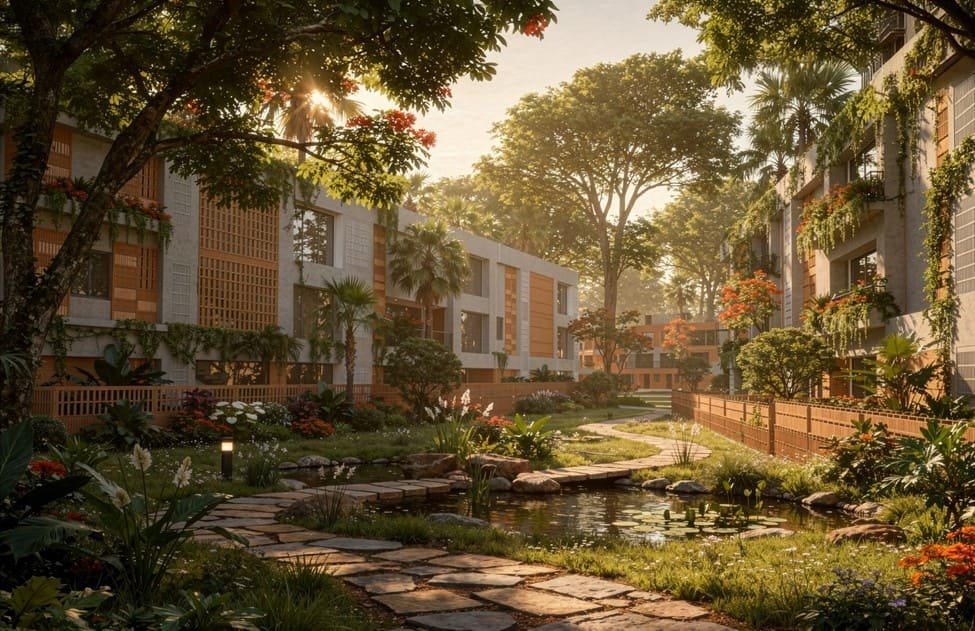
The principles outlined in this article have concrete expressions in the projects being developed for this buyer segment, and one of the clearest is White Lotus Amanvana. Located on IVC Road in North Bangalore, Amanvana stands among the most considered villas for sale in Devanahalli – a RERA-registered luxury villa community designed around the priorities of the end-user buyer: a density of approximately 7 homes per acre, 80% open spaces, net zero water community. private landscaped gardens with each villa, and an architectural approach that emphasises spatial quality, natural light, and Vaastu-compliant orientation.
The project is not designed to appeal to the buyer looking for a quick exit. It is designed for the buyer who has decided that the next home they choose is the one they intend to live in, and who understands that this decision is worth getting right. The community scale is intimate enough to foster genuine neighbourly relationships. The specification depth reflects an understanding of what discerning end-users actually notice and value after the sales process is over.
Amanvana is, self-consciously, a home rather than an investment vehicle. For buyers navigating the shift described in this article, from the investor mindset to the end-user commitment, it represents a considered answer to the question of what permanent living in North Bangalore can look like. More details, including project specifications and RERA information, are available at whitelotusamanvana.co.
What This Shift Means for Developers
The emergence of the end-user as the dominant force in luxury real estate has direct and demanding implications for developers. The product requirements of this buyer segment are not easily met by the templates and processes that produced the luxury apartment towers of the previous decade.
Density restraint is no longer optional for this segment. The instinct to maximise FSI, to extract the greatest number of saleable units from a given site, is fundamentally incompatible with what the end-user buyer values. Developers who build at densities that allow genuine spatial quality are not making a commercial sacrifice. They are building products that command a genuine premium and attract buyers who are less price-sensitive and more conviction-driven than the investor cohort.
Specification depth matters more than specification breadth. End-user buyers are not impressed by the length of the amenities list. They are interested in the quality of the things they will actually use every day. Ceiling heights, natural ventilation, acoustic separation between bedrooms and living areas, the quality of garden landscaping and its maintenance, the standard of kitchen fittings and bathroom hardware. Developers who invest in these fundamentals, rather than in the Instagram-friendly common areas that generate marketing content, are building homes that earn genuine loyalty.
Community governance is a product feature. The end-user buyer will live in the community they purchase into, potentially for decades. The quality of that community’s governance structure, how common areas are maintained, how disputes are resolved, and how decisions about the community’s evolution are made, is as important to their experience as the design of their individual home. Developers who treat post-handover community management as an afterthought are building a liability. Those who invest in governance design from the earliest stages of project planning are building something that retains its value and generates the kind of resident satisfaction that drives meaningful referrals.
Luxury Houses in Bangalore: HNI Property Trends in 2026
The end-user shift is part of a broader evolution in luxury property trends for HNIs across India. Several forces are converging to reshape what premium residential real estate means, and they all point in the same direction: toward product quality, experiential depth, and authenticity.
Wellness as Architecture
The amenity arms race of the previous decade is giving way to a more serious conversation about how the built environment affects health. This is reshaping what discerning buyers expect from luxury houses in Bangalore: natural light, air quality, thermal comfort, acoustic quality, and access to green space are increasingly core to the product proposition, not optional extras. Buyers who have experienced the difference between a home designed for wellbeing and one merely decorated to look luxurious are not willing to go back.
Sustainability with Substance
Environmental sustainability is no longer primarily a marketing claim in the luxury residential sector. A growing proportion of HNI buyers in 2026 are making genuine inquiries about solar infrastructure, rainwater harvesting, the embodied carbon of building materials, and the ecological management of landscaped areas. Developers who treat sustainability as a bolt-on feature are being clearly distinguished, unfavourably, from those who integrate it into the design process from the start.
The Quiet Luxury Aesthetic
The visual language of luxury in Indian residential real estate is in the middle of a significant revision. The opulent aesthetic of the previous generation, marble lobbies, gold-accented interiors, facades designed to announce their own expensiveness, is being replaced by something quieter and more confident. Natural materials used with restraint, spatial generosity expressed through volume rather than ornamentation, design that communicates quality through proportion and finish: this is what the 2026 HNI buyer finds compelling.
The quiet luxury aesthetic, which has reshaped fashion, hospitality, and product design globally, is arriving in Indian premium residential architecture. It is not a passing trend. It is a maturation of taste that reflects the sophistication of a buyer class that has seen enough of the world to know what genuine quality looks like.
A Note on Due Diligence for NRI Buyers
For NRIs evaluating luxury real estate in Bangalore in 2026, the end-user framing carries specific practical implications. The questions that matter most are not those a purely investment-led purchase requires. Instead of asking what the projected appreciation rate is, the relevant questions are: Is this home built and specified to a standard I would actually want to live in? Is the community the right size and character for the life I want? Is the developer’s track record one that I trust to deliver what has been promised?
RERA registration remains the most important baseline check for any buyer in Karnataka. It establishes a legal framework of accountability and provides access to project-specific documentation, including approved plans and registered specifications, that should be reviewed carefully before any commitment is made.
The legal framework for NRI residential purchases in India is well-established. FEMA regulations permit NRIs and Persons of Indian Origin to acquire residential property without prior approval from the Reserve Bank of India. Repatriation of sale proceeds is subject to standard conditions. Any buyer in this category should engage a property lawyer with specific NRI transaction experience before completing a purchase.
For those considering a community villa purchase, the maintenance and governance documentation deserves careful attention. Understanding who manages the community post-handover, what annual maintenance obligations look like, and how major expenditure decisions are made is essential information for any buyer expecting to live there for years.
The Home as a Considered Decision
There is something worth pausing to acknowledge in the shift this article has been tracing. The move from investor to end-user represents a kind of maturity in the relationship between people and the places they choose to live. For most of the past decade, the dominant script around property purchase among the affluent urban class was fundamentally deferring: the home was a stepping stone, an asset, a financial position. The question of what kind of home one actually wanted to live in was secondary to what it would be worth.
The buyers now reshaping Bangalore’s luxury market have, by and large, arrived at a point where the deferred question can no longer be put off. They have built their careers and accumulated their wealth. They have raised families in spaces that were adequate but not right. They have lived enough of life to know that the environment you wake up in every morning is not a minor consideration. It is one of the most consequential choices you make.
What they are choosing, with increasing clarity and confidence, is a specific kind of home: one that offers genuine privacy, a connection to the natural environment, a community of manageable scale, and architecture designed for people rather than for a brochure. These are not new human needs. They are ancient ones. What is new is the ability to meet them, in a form that is architecturally sophisticated and appropriately permanent, in a city that is still finding the shape of its maturity.
North Bangalore, and the gated community villas for sale in Bangalore that its best developers are now delivering, offers precisely this convergence – space, nature, permanence, and design that serves life rather than photographs it. That is the opportunity this buyer class has been waiting for, and it is one that a city still finding its shape is uniquely positioned to provide. It is an opportunity that, for developers who genuinely understand what these buyers are looking for, is among the most compelling in Indian residential real estate today.
Frequently Asked Questions
- Why is North Bangalore considered the best for luxury property trends for HNIs in 2026?
North Bangalore, particularly the IVC Road North Bangalore corridor, offers a unique combination of rapid infrastructure growth and preserved natural landscapes. Unlike the saturated eastern corridors, the North provides the land required for low-density residential projects in Bangalore, offering the privacy, cleaner air, and “Quiet Luxury” aesthetic that high-net-worth individuals now prioritize over central urban density.
-
What makes White Lotus Amanvana a preferred choice for end-user luxury homes Bangalore?
White Lotus Amanvana is specifically designed as a “Personal Sanctuary” rather than a speculative asset. With a boutique scale of only 95 villas across 14 acres (approx. 7 homes per acre), it offers a human-scale community. Each home features bespoke architecture, private landscaped gardens, and a Vaastu-compliant orientation, catering to those looking for a permanent, soulful residence.
-
Can NRIs legally manage an NRI real estate investment in Bangalore 2026?
Yes. Under current FEMA regulations, NRIs and OCIs can freely acquire residential property in India. For a successful NRI real estate investment Bangalore 2026, it is essential to ensure the project is RERA-registered (Amanvana RERA: PRM/KA/RERA/1250/303/PR/290825/008041) and to work with developers who provide transparent digital documentation and community governance structures.
-
What are the key features of gated community villas IVC Road?
The gated community villas IVC Road offers are characterized by expansive floor plans (typically 3,700-6,500 sq. ft.), high ceilings, and a focus on indoor-outdoor living. Proximity to the Kempegowda International Airport, world-class international schools like Stonehill and Vidyashilp, and upcoming SEZs makes this location a strategic hub for both lifestyle and long-term value retention.
- Is now a good time for premium villa buyers India to enter the North Bangalore market?
With property rates on IVC Road showing over 70% appreciation in the last three years and the Blue Line Metro extension nearing completion, 2026 represents a critical entry point. For premium villa buyers India-wide, the window to secure low-density land in managed communities is narrowing as Devanahalli transforms into a primary business and residential destination.