Quiet Luxury: A Guide to Thoughtful Design and Subtle Grandeur in Modern Villas
Quiet Luxury: A Guide to Thoughtful Design and Subtle Grandeur in Modern Villas
There is a certain kind of home that makes itself known through force: the lobby that commands attention, the facade that announces its own cost, the interior that layers material excess upon material excess until the cumulative effect is not elegance but pressure. You feel it immediately upon entering, the home’s ambition to impress.
And then there is a different kind. The home where you step inside and feel, almost inexplicably, at ease. This is the hallmark of quiet luxury homes that India’s new elite are seeking. The proportions are generous without being overwhelming. The light falls well. The materials are beautiful in a way you register slowly, not in the first glance but in the second, the third, the gradual accumulation of small well-made things that compose themselves into something coherent.
This is quiet luxury. And while the phrase has recently circulated widely enough to risk becoming a cliche, the sensibility it describes is genuinely distinct from what it replaces, more serious, more enduring, and more difficult to achieve well.
This guide is an attempt to explain what quiet luxury actually means in the context of villa interior design in Bangalore
What Quiet Luxury Is, and What It Is Not
The term quiet luxury gained widespread cultural currency in the West through fashion, where it described the aesthetic of brands like The Row, Brunello Cucinelli, and Loro Piana: garments made from extraordinary materials, cut with great precision, and designed to be recognised by those who understand quality rather than by those who read logos.
The translation of this sensibility to residential architecture is not merely metaphorical. It is about a fullness of quality, of craftsmanship, and of spatial comfort. A quiet luxury home is rich, in every sense, but it does not shout its richness. It is also not austerity; it is the ultimate expression of subtle elegance in interior design and the architecture itself.
Quiet luxury and minimalism are often spoken of in the same breath, and not without reason. Many of the most compelling quiet luxury interiors are visually spare: restrained palettes, uncluttered surfaces, a deliberate absence of decorative noise. The Japandi aesthetic, which has come to define much of contemporary high-end residential design globally, draws on both traditions simultaneously and is difficult to meaningfully separate from either.
The distinction, where it exists, is one of foundation rather than appearance. Minimalism, in its stricter sense, is motivated by the aesthetic of reduction itself – the idea that removing is a virtue, that the empty space is the point. Quiet luxury arrives at a similar visual place through a different logic: the restraint is in service of allowing material quality, light, and proportion to be experienced without competition. The room is not sparse because sparseness is the goal; it is spare because nothing present should distract from what is genuinely worth attention. A quietly luxurious home can be warm, layered, and sensory-rich while still reading as visually calm. The two sensibilities overlap more than they diverge, and the best contemporary villa interiors tend to draw on both without feeling the need to choose.
The Historical Roots of Understated Grandeur
The aesthetic sensibility of quiet luxury has a long history in residential design, even if the phrase itself is new. And for those living in Bangalore, the reference points are closer to home than they might appear.
The city’s older residential neighbourhoods – Basavanagudi, Malleswaram, Jayanagar in its early decades – were built around a particular understanding of what a good home required. Bungalows sat on generous plots, set back from the street behind compound walls and mature gardens. Verandas mediated between interior and exterior. Ceiling heights were generous not as a gesture of status but as a practical response to climate. The relationship between the house and its garden was not incidental but foundational – the garden was not decoration but an extension of the living space, used daily, designed to provide shade, fruit, and the particular quality of stillness that a well-planted urban plot can offer even in a growing city. These homes did not announce themselves. They rewarded the people who lived in them.
This tradition has parallels elsewhere. The great country houses of England derived their authority from proportion and their relationship to landscape rather than decorative excess. The Japanese concept of wabi-sabi located beauty in imperfection and transience. The Mughal garden tradition understood that space itself was the most powerful form of luxury. In more recent history, architects like Luis Barragán and Tadao Ando produced work that achieved richness through material honesty and the disciplined management of light rather than through accumulation.
What unites these traditions – and what connects them to Bangalore’s own residential history – is the conviction that a home’s first obligation is to the person living in it, not to the audience observing it from outside.
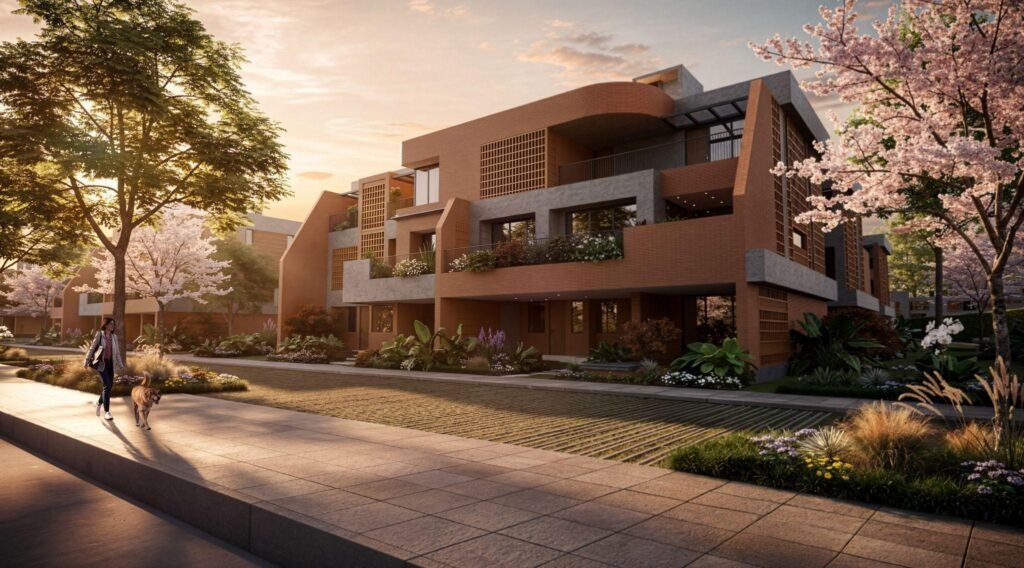
Source: White Lotus Amanvana
Villa Interior Design Principles That Create Quiet Luxury
- Material Authenticity Over Decorative Surface
The first and most important principle of quiet luxury in villa design is the preference for authentic materials over decorative surfaces. This distinction is fundamental and pervasive in its implications.
A decorative surface is a surface that mimics the qualities of a better material: tiles designed to look like marble, vinyl flooring designed to look like wood, composite panels designed to look like stone. These surfaces are not inherently bad, and in the right context they are entirely appropriate. But in a luxury villa designed for end-users who will live in the space for years, there is a gradual gap that opens between first impression and daily experience. What reads well in a show flat or a photograph does not always hold up to the slower, more intimate relationship of actually living with a material – the way it feels underfoot in the morning, the way it responds to touch, the way it ages through seasons of use. Authentic materials close that gap. They tend to give more over time rather than less, which is precisely the quality that makes a home feel worth returning to, year after year.
Authentic materials, by contrast, age differently. Natural stone develops a patina. Teak and rosewood deepen in colour with exposure. Lime plaster develops a quality of surface that no manufactured product replicates. Wire-cut bricks age gracefully and require less maintenance. These materials do not merely look better over time; they feel better. The sensory experience of a home whose materials are genuine is physically different from the experience of one whose surfaces only gesture toward quality.
The choice of authentic materials does not require that every surface be the most expensive option available. What it requires is that the materials chosen are genuinely what they present themselves to be, and that they have been selected with an understanding of how they will weather, feel, and behave over the ten, twenty, or thirty years that a villa’s interior will be in continuous use.
- Proportion and the Grammar of Space
After material quality, the most powerful contributor to the feel of a quietly luxurious villa is proportion. The relationship between the dimensions of a space, its height relative to its plan area, the width of corridors and openings, the scale of windows in relation to the walls that contain them, determines how a space feels more than almost any other design decision.
The conventional luxury apartment in India has suffered, in many cases, from a specific proportional problem: ceiling heights that are legally adequate but experientially cramped, combined with plan layouts that maximise saleable area at the cost of the spatial flow that makes large homes feel generous rather than merely large. A 4,000 square foot apartment with 9-foot ceilings and a layout that prioritises bedroom count over spatial quality does not feel luxurious. It feels like a bureaucratic distribution of area.
The relationship between dimensions determines how a space feels. A well-proportioned luxury villa in Bangalore uses its vertical dimension generously. This is a core element of the psychology of space article mentioned in previous discussions – the way volume dictates comfort.
The grammar of spatial sequence matters equally. The transition from exterior to interior, the movement from a relatively compressed entry space to the generosity of a main living area, the progression from communal to private zones within the home, all of these sequences can be managed in ways that create narrative and delight, or they can be handled as purely functional routing problems. The quiet luxury home treats spatial sequence as a design opportunity.
- Light as the Primary Material
If there is a single design element that most reliably distinguishes a quietly luxurious home from one that merely contains expensive things, it is the quality of natural light. Light is, in architecture, a primary material: it reveals or conceals, it creates mood and atmosphere, it connects the interior to the natural world, and it changes continuously in ways that make a well-lit space feel alive rather than static.
Good natural light in a villa requires several things simultaneously. It requires orientation: the principal living spaces should face directions that provide useful light at the times of day they are most used, morning light for bedrooms and breakfast areas, midday and afternoon light for living and working spaces. It requires window placement: not merely the insertion of openings to satisfy building code requirements, but a considered decision about where and how light enters each space, including the management of glare, the use of high clerestory windows to introduce diffuse overhead light, and the relationship between windows and surfaces that reflect or absorb the light they admit.
It also requires restraint. A common mistake in aspirational residential design is the assumption that more light is always better, leading to all-glass facades and maximally glazed living spaces that are, in practice, either blinding in direct sun or dependent on mechanical cooling to be habitable. The quiet luxury approach to light is more considered: the right quantity of light, at the right time of day, in the right places, managed through a combination of orientation, window design, and architectural elements like deep overhangs, screened verandas, and interior courtyards.
- The Indoor-Outdoor Threshold
One of the defining characteristics of villa design at its best is the quality of the relationship between interior living space and the private garden. This threshold, the point where the inside becomes the outside, is one of the most architecturally charged moments in any home, and the way it is handled is a reliable indicator of the design intelligence of the project as a whole.
In many luxury villa projects, the indoor-outdoor relationship is handled as a matter of specification: large sliding glass panels, a terrace that extends the floor level of the living room, a garden visible through the glazing. These are necessary elements, but they are not sufficient. The quiet luxury approach goes further.
The threshold is conceived as a transition space rather than a hard boundary: a veranda or covered outdoor room that is neither fully inside nor fully outside, that mediates between the air-conditioned interior and the open garden, that provides shade from direct sun while maintaining visual and sensory connection to the landscape. This intermediate space is, in the experience of most residents, one of the most used parts of the home: the place for morning tea, for evening reading, for informal family time that wants the quality of outdoors without the full exposure to weather.
The landscape beyond this threshold is designed with the same deliberateness as the interior. Plants are chosen not merely for visual effect but for their seasonal behaviour, the way they change through the year, the scents they produce, the insects and birds they attract. The spatial layout of the garden creates depth and layering rather than presenting a flat, undifferentiated green surface. There are places to sit that offer different experiences, some more exposed, some more sheltered, some oriented toward the sky and some toward planted screens that create the experience of being within a landscape rather than adjacent to one.
- The Staggered Layout and Its Benefits
A characteristic design feature of genuinely well-considered luxury villa projects is the use of staggered layouts: plans in which the villa’s volumes are arranged not in a simple rectilinear block but in an L-shape, a U-shape, or a more complex stepped arrangement that creates multiple relationships between the built form and the landscape, between private and semi-private zones, and between different parts of the home.
The staggered layout serves several simultaneous purposes. It creates protected outdoor spaces, courtyards or garden rooms that are partially enclosed by the building’s own mass, and therefore sheltered from wind and with a greater sense of privacy than a garden simply adjacent to a rectangular building. It allows different zones of the home to have different orientations, so that the master bedroom can face a different direction from the living areas, each optimised for its own use pattern and light requirements.
The staggered layout also creates visual complexity when viewed from outside: the building does not present a single dominant face but a series of volumes that relate to each other and to the landscape in ways that are readable from multiple viewpoints and that reveal themselves gradually as you move around the exterior. This is, in architectural terms, a form of visual generosity: the home has more to offer the eye than a single view can exhaust.
- Vaastu for Home Interiors as Design Intelligence
Vaastu for home interiors is often reduced, in contemporary real estate discourse, to a checklist of compliance items. The main entrance must face a certain direction, certain rooms must not be in certain positions, certain colours and materials are preferred or avoided. This reductive reading misses the genuine intelligence of the Vaastu tradition.
At its core, Vaastu is a system of spatial thinking that integrates orientation and the movement of natural elements. When creating Vaastu compliant luxury homes, the preference for north and east-facing aspects reflects a sophisticated understanding of solar geometry. This corresponds to practical insights about noise and light that an architect would arrive at independently.
When these principles are integrated from the beginning, the result is a home that works well in the physical sense. This is why the best developers treat Vaastu for home interiors seriously as a design discipline – not a marketing checkbox but consistently produce homes that feel more liveable over time.
Craftsmanship: The Quiet Signature of a Well-Made Home
There is a particular kind of detail that you notice only after you have lived with it for a while. Not the sweeping gesture or the statement material, but the way a door closes: the soft, definitive click of a well-hung door on precisely fitted hinges. The way a built-in shelf meets the wall behind it, not with a caulked gap but with a shadow line so clean it looks inevitable. The drawer that opens without a handle because the joiner has recessed the front panel with enough precision to make a grip unnecessary.
This is craftsmanship. And in a quiet luxury home, it is everywhere – not announced, but accumulated.
Joinery as the True Specification Test
Of all the elements in a luxury villa, joinery is the most revealing. A developer can install expensive stone and import premium plumbing fixtures, and these choices are visible in the showroom and in the sales brochure. But the quality of built-in cabinetry, wardrobes, kitchen furniture, and bookshelves is only truly legible over time – after the first humid season, after the first year of daily use, after the novelty of newness has worn away and the home reveals what it is actually made of.
Good joinery begins with solid material choices: frames built from properly seasoned timber or high-density engineered cores, not hollow sections covered with a surface veneer. It continues with joints that are mechanically sound – mortise and tenon, dovetailed corners, properly glued and clamped rather than stapled and hoped for. And it concludes with hardware: hinges, handles, drawer slides, and closing mechanisms that operate smoothly and silently not just at handover but after ten years of continuous use.
The gap between adequate joinery and excellent joinery is not always visible at first glance. It is felt, over time, in the absence of problems: doors that do not warp, drawers that do not stick, finishes that do not peel at the edges.
The Detail at the Junction
Every home contains dozens of moments where two materials or two architectural elements meet. The joint between a stone floor and a timber staircase. The transition between a plastered wall and a timber panel. The point where a ceiling drops to accommodate a beam, or rises to accommodate a void. These junctions are moments of decision in building design, and they are almost always where the difference between a considered project and a merely expensive one becomes most apparent.
In quiet luxury design, these junctions are treated as design opportunities rather than technical problems to be resolved with a bead of sealant. Shadow lines – deliberate recessed reveals between elements – are used to create visual depth and a sense of precision that flat, undetailed transitions cannot produce. A reveal of even eight or ten millimetres between a ceiling panel and a wall transforms a functional junction into an architectural detail; it signals that someone thought carefully about this moment, that it did not simply happen.
The effect, cumulatively, is a home that feels resolved. Nothing jars. Nothing draws attention to itself through awkwardness or imprecision. The details retire into the background, which is precisely their purpose.
The Human Scale of Making
There is also something more difficult to quantify in the presence of genuine craft: the evidence of human attention. A hand-plastered wall has a quality of surface – slight variation, warmth, depth – that no machine-applied finish replicates. A piece of joinery cut and fitted by a skilled carpenter to the exact dimensions of a specific room carries a quality of belonging that factory-produced furniture, however well designed, cannot achieve.
This does not mean that quiet luxury homes are exclusively the province of artisanal production. Many of the best contemporary finishes – engineered timber, precision-cut stone panels, high-specification hardware – are industrially produced. What matters is not the method of manufacture but the quality of intention behind the specification and the rigour of the execution on site.
The quietly luxurious home is one where someone – the architect, the interior designer, the site supervisor – has cared about every junction, every finish, every detail that the resident will touch or see in the ordinary course of daily life. That care is invisible when it succeeds. Its absence, when it fails, is impossible to ignore.
The Details That Don’t Lie: Junctions, Reveals, and Joinery in Luxury Villa Design
The difference between a luxury villa and a genuinely well-made luxury villa is often most visible in the treatment of architectural details, the moments where two materials meet, where a structure transitions between functions, where the building reveals its constructional logic.
Junctions where two materials meet are always moments of decision in building design. The joint between a stone floor and a timber staircase, the transition between a plastered wall and a timber panel, the detail of how a glass door meets the floor, all of these can be handled in ways that are technically adequate but visually awkward, or in ways that are elegant and intentional. The quietly luxurious home treats every junction as a design moment.
Shadow lines, the deliberate creation of recessed reveals between elements, are a characteristic feature of refined contemporary architecture. A shadow line between a ceiling panel and a wall, or between a built-in furniture element and the surface behind it, creates visual depth and a sense of precision that flat, undetailed transitions cannot produce. These details cost time and craftsmanship to execute well, and their presence is a reliable indicator of a project’s commitment to quality.
The quality of joinery, particularly in built-in furniture, wardrobes, kitchen cabinetry, and bookshelves, is one of the most revealing tests of a villa’s actual specification level. Good joinery involves solid material choices, properly managed joints, hardware that operates smoothly and silently after years of use, and finishes that have been applied with enough thickness and care to resist the scratches and impacts of daily life. Poor joinery, regardless of how expensive the veneer surface may be, reveals itself within a few months of occupation.
Amanvana: A Luxury Villa in Bangalore Built for Wellbeing
The principles described in this article are not hypothetical. They have concrete expression in one of the most considered luxury villas in Bangalore currently available to buyers – White Lotus Amanvana on IVC Road, Devanahalli.
The design approach at Amanvana reflects several of the core principles this article has examined. The Vaastu-compliant orientation is not a post-hoc adjustment but a foundational design decision that shapes the siting of each villa on its plot, the orientation of principal rooms, and the relationship between the built form and the private landscape. The material approach prioritises authentic, quality-first choices over decorative substitutes. The spatial layout, with its careful management of the indoor-outdoor threshold and its attention to how natural light moves through the home at different times of day, reflects a design team that has thought seriously about what it means to live in a villa of this kind over many years.
The community scale, approximately 7 homes per acre, is itself a design decision of the quiet luxury kind: not maximising saleable units but creating the spatial conditions in which a certain quality of residential life is genuinely achievable. The private gardens are not token outdoor spaces but genuine landscapes designed to be inhabited, to age well, and to provide the daily restorative value that the architecture of low-density living makes possible.
For those exploring villas for sale in North Bangalore, Amanvana represents a meaningful reference point for what considered design at this level actually looks like.
Commissioning with Intention: Advice for Buyers
For buyers approaching the purchase of a luxury villa with the aesthetic sensibility this article has described, a few practical considerations are worth foregrounding.
Understand the difference between interior design and architecture. The quality of a villa’s architecture, its proportions, its orientation, its management of light and space, is fixed at the time of construction and cannot be changed by interior design, however expensive. These structural qualities deserve the most careful attention in the evaluation process.
Evaluate finishes at full scale and over time. The experience of materials in a small sample or a show flat is not the same as the experience of those materials at the scale of a whole room, under different lighting conditions, and after several years of use. Ask to see completed projects from the developer. Visit homes that have been occupied for two or three years and observe how the materials have aged.
Consider the relationship between the villa and its garden as a single design. The most successful luxury villas are ones where the interior and exterior design have been conceived together, where the garden is not an afterthought to the architectural design but an integral part of the residential experience. Look carefully at how the indoor-outdoor threshold is designed, how the garden relates to the principal living spaces, and what the garden’s landscape design actually contains.
Think about the acoustic environment. Quiet luxury is, among other things, about quiet: the acoustic quality of the home at different times of day, the degree to which external sounds intrude, the acoustic relationship between different rooms within the home. These are qualities that are difficult to evaluate in a show flat but become highly significant in daily life.
Conclusion: The Case for Designing Well
The quiet luxury aesthetic is, at its most fundamental, a case for taking design seriously. It rests on the conviction that the quality of the environments we inhabit has a profound effect on the quality of our lives, that beautiful, well-made, thoughtfully proportioned spaces contribute to wellbeing in ways that exceed any quantifiable measure, and that the decision to invest in genuine quality, in materials, in space, in craftsmanship, and in the careful integration of the home with its natural setting, is one of the most meaningful choices a person can make.
This is not a counsel of perfection. No home is perfect. The choice is never between a perfectly designed space and an adequately designed one, but between a design process that takes these questions seriously and one that treats them as secondary to speed, cost, or saleable area.
For buyers currently reshaping the luxury residential market, those exploring villa interior design ideas for homes they intend to live in for decades, and those considering villas for sale in North Bangalore where land, density, and design quality intersect most favourably – the quiet luxury standard is increasingly the relevant one. They are not looking for homes that impress visitors. They are looking for homes that reward habitation: that reveal new qualities over time, that feel right in ways that are difficult to articulate but immediately recognisable, and that serve the lives of the people who live in them with the same intelligence and intention that those people bring to everything else they do.
That is a high standard. It is also, on the evidence of projects like those emerging in Devanahalli’s IVC Road corridor, an achievable one. The question is simply whether you know what to look for.
Frequently Asked Questions
- Is quiet luxury relevant to the Indian residential market, or is it a Western concept?
The sensibility is entirely at home in India. The Mughal garden tradition, the material intelligence of South Indian stone craft, the spatial logic embedded in Vaastu – all of these are native expressions of the same underlying conviction: that the highest form of residential design serves the person living in it, not the audience observing it. Quiet luxury, in the Indian context, is less an imported aesthetic than a return to a design standard that was always here.
- How does Vaastu for home interiors work in a luxury villa in Bangalore?
In a well-designed luxury villa, Vaastu is not applied as a checklist after the architecture is decided – it is integrated from the very beginning as a framework for spatial thinking. The orientation of principal rooms toward the north and east maximises beneficial natural light and thermal comfort through the day. The placement of the kitchen, the master bedroom, and the entry sequence follows principles that align the home’s energy flow with its occupants’ daily rhythms. When this is done correctly, the result is not a home that has “passed” a Vaastu compliance check – it is a home that simply feels right to live in, where the light falls well, the air moves freely, and each room serves its purpose with a quality of ease that is difficult to attribute to any single decision but is the cumulative result of many considered ones
- Why is proportion so critical in luxury villa design Bangalore?
Proportion is the “grammar of space.” In luxury villa design Bangalore, achieving a sense of grandeur without excess depends on vertical volume. Quiet luxury villas, like White Lotus Amanvana, utilize ceiling heights to allow natural light to penetrate deeper and create a sense of spatial generosity that standard apartment ceilings simply cannot match.
- Are White Lotus projects considered Vaastu compliant luxury homes?
Yes. However, at White Lotus, we treat Vaastu as “spatial intelligence” rather than a mere checklist. Our Vaastu compliant luxury homes integrate ancient principles of solar geometry and airflow into the fundamental architecture. By orienting living spaces to the north and east, we maximize beneficial natural light and thermal comfort, creating a home that is both culturally aligned and scientifically restorative.
- What should buyers look for when considering villas for sale in North Bangalore?
The most important factors are architectural quality over specification level: the orientation of the home, ceiling heights, the design of the indoor-outdoor threshold, and how the garden relates to the principal living spaces. These are fixed at construction and determine how the home performs over decades.
Instagram | LinkedIn | Whatsapp