Designing for Well-being: The Architectural Soul of Luxury Villas in Bangalore
Introduction:
As Bengaluru evolves, so does the way people think about home.
For decades, luxury in residential design was often associated with scale – larger homes, grand façades, and ornamental finishes. Today, however, the conversation around luxury villas in Bangalore is shifting toward something more meaningful: the quality of everyday living.
A thoughtfully designed home does more than provide shelter. It quietly shapes how we think, rest, interact, and recharge. The way light moves through a room, the way fresh air circulates across spaces, and the way nature is allowed to coexist with architecture all influence how we experience daily life.
For discerning homeowners in 2026, architecture is increasingly being evaluated through a simple but powerful question:
Does this home support the rhythm of life within it?
Across thoughtfully planned gated community villas in Bangalore, architecture is beginning to reflect this shift. Homes are being designed not merely as physical structures but as environments that nurture clarity, calm, and connection.
Chapters
- Introduction
- The Role of Natural Light in Luxury Villas in Bangalore
- Designing Homes That Breathe: Ventilation in Modern Villas
- Spatial Openness: The Rise of Fluid Layouts
- Acoustic Comfort: Designing for Quiet Living
- Biophilic Design: Bringing Nature into Daily Life
- Technology Supporting Wellness
- North Bangalore: A New Landscape for Villa Living
- Amanvana: Architecture Designed Around Well-being
- The Future of Thoughtful Living
- Step Into Your Sanctuary (Call to Action)
- Frequently Asked Questions (FAQs)
The Role of Natural Light in Luxury Villas in Bangalore
Natural light remains one of the most powerful yet understated elements of residential design.
In well-designed luxury villas in Bangalore, the orientation of the home is carefully studied to maximise daylight while minimising heat gain. Large openings, skylights, and internal courtyards allow sunlight to penetrate deeper into living spaces, creating interiors that feel bright, open, and uplifting.
Beyond aesthetics, natural light plays an important role in human health. Exposure to daylight helps regulate circadian rhythms – the internal clock that governs sleep patterns, mood, and energy levels.
Homes designed around natural light therefore tend to feel more aligned with the body’s natural rhythm.
Many contemporary new villa projects in Bangalore incorporate architectural features such as double-height living spaces, wide windows, and landscaped courtyards to bring daylight into the heart of the home.
Over time, these seemingly simple design decisions create living environments that feel healthier and more energising.
Designing Homes That Breathe: Ventilation in Modern Villas
One of the greatest advantages of a villa over a dense apartment block is the ability to design for natural airflow.
In ready-to-move villas in Bangalore, good ventilation is often the result of deliberate architectural planning rather than mechanical intervention.
Openings are placed on opposite sides of rooms to encourage cross-ventilation. Internal courtyards and vertical voids allow warm air to rise naturally, drawing cooler air from gardens and shaded outdoor areas.
This approach, sometimes referred to as stack ventilation, creates homes that feel alive with movement. Fresh air circulates naturally through spaces rather than being trapped inside sealed environments.
The result is a home that feels lighter, fresher, and more comfortable throughout the year.
Over time, these subtle design decisions contribute not just to comfort, but also to the long-term health of those who live within the space.
Spatial Openness: The Rise of Fluid Layouts
Modern residential architecture is also moving away from rigidly compartmentalised interiors.
In many luxury independent house designs in Bangalore, spaces now flow more naturally into one another. Living rooms extend into gardens, dining spaces open into courtyards, and terraces become natural extensions of indoor living areas.
This openness creates a sense of spatial freedom while maintaining distinct zones for privacy and rest.
Higher ceilings often enhance this sense of openness by allowing more light and air to circulate through the home.
These architectural choices help create homes that feel expansive yet intimate, adaptable to both quiet evenings and lively gatherings.
Acoustic Comfort: Designing for Quiet Living
In an expanding metropolitan city, silence is increasingly becoming a form of luxury.
For buyers exploring premium villas in Bangalore, acoustic comfort is often a key consideration when evaluating residential communities.
Low-density planning plays an important role here. When homes are spaced further apart, external noise levels naturally reduce. Landscaped buffers, gardens, and internal courtyards further soften the sounds of surrounding urban activity.
Inside the home, thicker masonry walls, insulated glazing, and layered landscaping help maintain calm interiors.
The result is not complete silence but a gentler soundscape, where the sounds of wind through trees or birds in the garden replace the constant background hum of traffic.
Biophilic Design: Bringing Nature into Daily Life
Across many villas in North Bangalore, architects are increasingly embracing the concept of biophilic design.
Biophilic design focuses on strengthening the relationship between people and nature. Homes are planned around gardens, courtyards, shaded pathways, and landscaped green corridors that allow residents to remain connected with natural surroundings throughout the day.
Rather than separating indoor and outdoor environments, modern villas often blur the boundaries between the two.
Morning light filtering through trees, open terraces overlooking gardens, and shaded walkways encourage residents to slow down and engage more deeply with their surroundings.
Studies in environmental psychology have shown that regular exposure to natural environments can significantly reduce stress while improving mental well-being.
Technology Supporting Wellness
Technology is also becoming an integral part of modern residential architecture, though often in subtle ways.
In sustainable luxury villas in Bangalore, smart systems can help regulate lighting, indoor air quality, and temperature while remaining unobtrusive.
Lighting systems may gradually shift brightness levels throughout the day to mimic natural daylight cycles. Automated shading systems help manage heat while preserving views.
When integrated thoughtfully, technology works quietly in the background, supporting the architectural design rather than competing with it.
North Bangalore: A New Landscape for Villa Living
Location plays a significant role in shaping residential well-being.
In recent years, villas in North Bangalore have gained increasing attention due to the region’s expanding infrastructure and relatively lower density compared to central Bengaluru.
Several major infrastructure developments are contributing to this growth:
• The Namma Metro Blue Line, connecting KR Puram to Kempegowda International Airport
• The Satellite Town Ring Road (STRR) improving connectivity between Bengaluru and surrounding towns
• The Kempegowda International Airport business corridor, attracting aerospace, technology, and logistics companies
• Proximity to emerging commercial hubs around Devanahalli and the airport region
These developments are transforming North Bengaluru into one of the city’s most promising residential corridors.
At the same time, the region continues to offer larger land parcels and greener surroundings, conditions that allow developers to create thoughtfully planned villa communities.
Amanvana: Architecture Designed Around Well-being
One example of this evolving approach to residential design is Amanvana – Home of Sanctuaries, a villa community developed by White Lotus in North Bengaluru.
Located off the IVC Road corridor in Indrasanahalli, Amanvana has been planned around the idea that architecture should support both solitude and community.
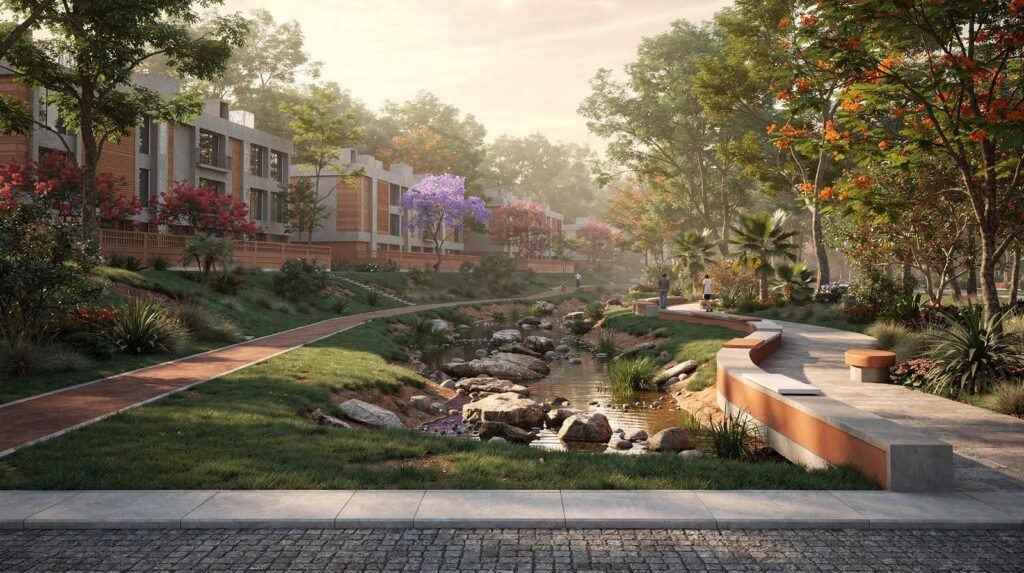
Spread across approximately 14 acres with nearly 70% open space, the community prioritises landscape and breathing room over built density. The masterplan is designed at a consciously low density of around seven homes per acre, allowing homes to maintain privacy while remaining connected to shared green spaces.
Instead of rigid rows of homes, the layout creates a network of landscaped pathways, courtyards, and green corridors that encourage slower, more mindful movement through the community.
Villas are thoughtfully staggered to maintain privacy, ensuring that balconies and living spaces do not directly overlook neighbouring homes.
Nature plays a central role in the planning, with indigenous trees, shaded pathways, and garden courtyards woven throughout the neighbourhood.
This approach reflects a broader shift in how modern villa communities in Bangalore are being imagined today – not simply as larger homes, but as environments designed to support everyday well-being.
The Future of Thoughtful Living
As cities grow denser and faster-paced, the importance of thoughtful residential design will continue to increase.
Homes that prioritise natural light, ventilation, spatial openness, and connection with nature offer a more balanced way of living.
For homeowners seeking comfort, privacy, and long-term value, architecture designed around well-being is likely to define the next generation of luxury villas in Bangalore.
In many ways, the future of residential architecture is not about building bigger homes.
It is about building homes that allow life to unfold more naturally.
Step Into Your Sanctuary
Discover a sanctuary where architecture, landscape, and everyday life come together at Amanvana – Home of Sanctuaries by White Lotus.
Schedule an Experiential Visit at Amanvana
Frequently Asked Questions (FAQs)
- How does architecture impact mental well-being?
Design elements like ceiling heights, natural light, and intuitive flow reduce “visual clutter” and stress, creating a psychological sense of calm and order.
- Why is natural light emphasized in modern villa design?
Beyond energy efficiency, natural light is essential for regulating circadian rhythms and improving mood, making it a critical health component.
- Does low-density living affect air quality?
Yes. Low-density developments like Amanvana allow for better wind movement and less trapped heat, ensuring fresher air circulation compared to crowded urban clusters.
- What is “biophilic integration” in a luxury home?
It is the intentional blending of natural elements like gardens and water-conscious landscapes into the living space to improve emotional restoration.
- Why are buyers prioritizing wellness-focused homes in North Bangalore?
As urban life becomes more fast-paced, the home is viewed as a place for recovery. Buyers seek environments that actively support their health, benefiting from the lower density and better infrastructure of the northern corridors.