The Devanahalli Decoupling: North Bangalore's Transformation Into a Premium Residential Destination
Introduction
For most of Bangalore’s residential history, the city’s gravitational centre has sat somewhere between MG Road and Koramangala, a band of inner Bangalore that defined the address, the social life, and the professional infrastructure of its most ambitious residents. North Bangalore, and Devanahalli in particular, existed in this mental geography as the city’s logistics appendix: the location of the airport and the KIADB industrial zones, useful for businesses that moved goods or depended on air freight, but not a place where anyone of professional ambition chose to live.
That geography is obsolete. What has happened in North Bangalore over the last five years is better described as a decoupling: the corridor has separated from its historical identity as an airport suburb and emerged as something genuinely and qualitatively different. Property in North Bangalore now sits at the centre of a self-sustaining urban ecosystem with its own institutional infrastructure, professional community, lifestyle fabric, and economic logic.
The claim is not that North Bangalore has replaced the city’s other premium corridors. It is something more specific and more interesting: that it has developed to a point where the trade-offs it once required – the distance from schools, hospitals, restaurants, culture, and professional networks – have been resolved to a degree that changes the calculation for a meaningful segment of Bangalore’s most discerning residents.
This piece examines the evidence for this claim and explains why the investment case for Devanahalli real estate has become one of the stronger ones in the city’s current market.
Chapters
- Introduction
- The Historical Narrative and Why It No Longer Applies
- The Education Anchor: What Elite Schools Mean for Devanahalli Real Estate
- The Institutional Infrastructure: Sports, Health, and Premium Amenity
- The Economic Engine: GCCs, Aerospace, and the Knowledge Economy
- Villas Near Bangalore Airport: Where the Premium Is Crystallising
- The Low-Density Premium: Plots in Devanahalli and What No Other Corridor Can Offer
- The NRI Investment Perspective on Property in North Bangalore
- Amanvana: At the Centre of Something New
- What the Data Says: Key Indicators of the Corridor’s Maturation
- Living in Devanahalli in 2026: An Honest Assessment
- The Infrastructure Pipeline: Metro, BIAL, and What Is Coming
- The Investment Horizon: Why the Timing Argument Favours Action
- Conclusion: The Decoupling is Complete
The Historical Narrative and Why It No Longer Applies
The story of North Bangalore’s undervaluation as a residential corridor is straightforward. The opening of Kempegowda International Airport in 2008 created an initial burst of speculative real estate activity, driven by the assumption that airport proximity would attract corporate investment and residential development. Some of that assumption proved correct: the KIADB Aerospace SEZ attracted manufacturing and aerospace firms, and a number of technology companies established campuses in the Devanahalli corridor.
But the anticipated residential premium did not materialise quickly. The corridor’s social infrastructure – schools, hospitals, retail, dining, and entertainment – lagged significantly behind the residential development activity. Families who moved to North Bangalore for the space and relative affordability found themselves commuting back to central Bangalore for almost every significant urban amenity. The quality of the road infrastructure, before the completion of the NH44 improvements and the NH648 expressway project, made those commutes genuinely painful.
The result was a corridor that attracted buyers motivated by investment speculation or by the specific operational need to be near the airport – not by the quality of the residential and social environment itself. This limited the depth of the premium market and reinforced the narrative of North Bangalore as a secondary, peripheral address.
Several things have changed since 2020, and particularly since 2022, that have fundamentally altered this dynamic. Together they constitute a qualitative shift, not merely a quantitative improvement. The sum of these changes is greater than their parts: each individual improvement has a multiplier effect on the others, and the cumulative result is a corridor that has crossed a threshold of self-reinforcing quality that Koramangala and Whitefield also crossed at particular points in their development histories.
The Education Anchor: What Elite Schools Mean for Devanahalli Real Estate
Among all the factors that drive residential premiums, school quality is the one that moves families first. This is a consistent finding across every major real estate market in the world, and India is no exception. Families with the means to choose will pay substantial premiums, in both home prices and rents, to live within the catchment of schools they consider genuinely excellent for their children. The converse is equally true: the absence of such schools is one of the most effective caps on residential premium in any corridor.
North Bangalore’s transformation in this regard has been substantial. The establishment of internationally affiliated schools in and around the Devanahalli corridor has addressed the single most common objection of premium residential buyers who otherwise liked everything about the area. When a school of genuine international standing is within a reasonable drive of your home, the calculation changes not just for one family but for an entire community of similarly minded families who are making the same assessment simultaneously.
Several internationally affiliated schools have established a presence in and around the Devanahalli corridor, and together they have addressed the single most common objection of premium residential buyers who otherwise liked everything about the area. Stonehill International School, operating on the Cambridge International curriculum, has been an early and consistent anchor. More recently, Harrow International School Bangalore and Vidyashilp Academy have added further depth to the corridor’s education offering – bringing with them the kind of institutional credibility that families relocating from the UK, US, or the Gulf actively seek. The cumulative effect is a cluster of residential options within a 20-30 minute drive of multiple quality schools, creating a natural premium zone along IVC Road and through the Devanahalli township area that did not exist five years ago.
Educational anchors create virtuous cycles that are among the most reliable and durable drivers of residential value appreciation. As the community of families who have moved to North Bangalore partly for the school infrastructure grows, the quality of the surrounding social environment improves, which in turn attracts more families, which supports more retail and dining and recreational investment. The presence of multiple quality schools in the corridor means this self-reinforcing dynamic is already well advanced.
The Institutional Infrastructure: Sports, Health, and Premium Amenity
The Sports Excellence Centre
North Bangalore has quietly assembled a set of sports and recreational institutions that would be remarkable in any city, let alone a peripheral corridor. The Padukone-Dravid Centre for Sports Excellence brings together two of India’s most respected sporting legacies under one roof, offering professional-grade training infrastructure across multiple disciplines. To The Tee Golf Centre caters to a demographic that overlaps almost entirely with the corridor’s premium residential buyer profile. The Embassy International Riding School adds an equestrian dimension that is genuinely rare in Indian residential corridors and carries significant lifestyle cachet for families with international living experience. For the premium residential buyer, this concentration of serious, high-quality sports infrastructure is not a peripheral amenity – it is the kind of institutional fabric that defines a lifestyle address and is impossible to replicate in the city’s densely built inner corridors.
Combined with the natural landscape of North Bangalore – the open terrain, granite outcroppings, and lower density that give the corridor a genuinely different physical character – the lifestyle case for active, health-oriented residents has become compelling in a way that few Bangalore addresses can match. The combination of institutional sports infrastructure and a landscape that actively invites outdoor use creates a recreational environment that the city’s inner corridors, however well-served in other respects, simply cannot replicate at this scale.
Healthcare Infrastructure: A Critical Gap Closing
Healthcare access has historically been one of North Bangalore’s weaker points for permanent residential use. This picture has changed substantially. Investment in healthcare infrastructure has accelerated considerably, with established healthcare providers recognising that the demographic and economic profile of the corridor’s growing resident population justifies the establishment of full-service facilities. Multi-speciality hospitals with emergency capabilities have materially reduced the healthcare access gap that was previously a significant deterrent to permanent family residential commitment to the corridor.
Retail, Dining, and the Urban Texture
The luxury retail and hospitality gap that characterised North Bangalore until recently is closing. Several premium hotel brands have established a presence in the corridor, responding both to the airport proximity and to the growing permanent resident base. The luxury retail and hospitality gap that defined North Bangalore is closing fast. Taj Bangalore anchors the corridor near the airport, IHCL has announced a SeleQtions property in Devanahalli, and the Radisson Individuals resort at Mulberry Shades positions itself squarely for the resident market rather than transit travellers. On the retail side, Bhartiya Mall of Bengaluru at Thanisandra – home to Marks & Spencer, Rare Rabbit, Hidesign, and a full dining floor – has shifted the calculus considerably, and Phoenix Mall of Asia in Hebbal has pulled Zara, Puma, and Hamleys into the northern quadrant. Prestige’s Forum 13° North in Yelahanka adds another million-plus sq ft of organised retail to the pipeline. The rule holds: retail follows rooftops, and the rooftops here are now good enough to attract the retail that matches them.
The Economic Engine: GCCs, Aerospace, and the Knowledge Economy
The professional community that a residential corridor attracts is as important as its social infrastructure, and here Devanahalli’s positioning is particularly strong. The KIADB Aerospace SEZ and the broader technology and business process corridor that has developed along NH44 and the peripheral ring road represents a substantial and growing cluster of knowledge-economy employment. Several of India’s largest technology services companies have campuses in the corridor.
Global Capability Centres – the R&D, analytics, technology, and business operations arms of multinational corporations – have been establishing and expanding in Bangalore at an extraordinary rate. Bangalore hosts the highest concentration of GCC facilities among Indian cities. The professionals who staff these centres: senior engineers, analytics leads, finance and compliance specialists, represent exactly the demographic that premium residential developers are targeting. A meaningful share of this GCC expansion has been located in North Bangalore, creating a co-location dynamic between professional employment and premium residential supply that is the classic engine of sustained residential value growth.
The corridor’s aerospace and defence employment base contributes a specific and somewhat unusual professional community character. The scientists, engineers, and technical specialists who work in the aerospace sector are typically highly educated, internationally experienced, and professionally accomplished – a cohort with strong cultural and educational values who make demanding and thoughtful residential choices. Their concentration in and around Devanahalli has contributed to the corridor’s distinctly technical and intellectual professional character.
Villas Near Bangalore Airport: Where the Premium Is Crystallising
Within North Bangalore’s broader story, the IVC Road corridor – running from Hebbal through Yelahanka and into the Devanahalli township is where premium residential development is most concentrated. The primary connectivity spine is Bellary Road (NH44), which gives residents a relatively direct route into the city. The STRR, inaugurated in its first stretch in March 2024, adds a meaningful orbital link connecting Devanahalli to Doddaballapur and Hoskote, with the full 280km ring still under construction. The proposed metro Blue Line extension to the airport, currently at roughly 50% physical progress, would add a further layer when it opens, expected in late 2026 or early 2027. The commute is not frictionless, but the infrastructure trajectory is better defined here than in most of Bangalore’s other peripheral corridors.
The growing demand for villas near Bangalore airport reflects the cumulative effect of multiple positive factors landing in the same geography simultaneously: good connectivity, available land at viable prices, proximity to the employment base, access to new institutional infrastructure, and a natural landscape setting considerably more attractive than what is available closer to the city’s core.
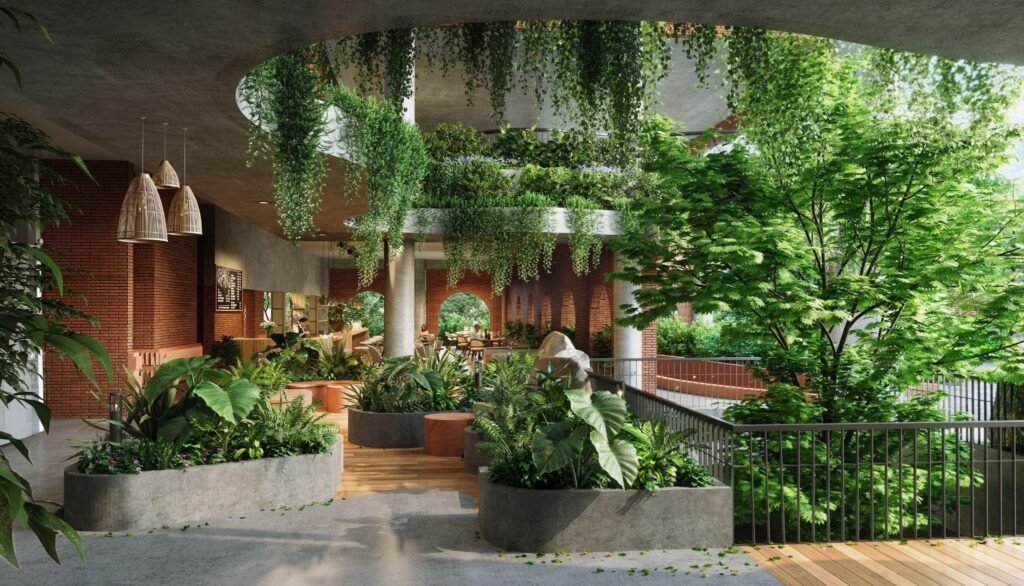
Source: White Lotus Amanvana
The Low-Density Premium: Plots in Devanahalli and What No Other Corridor Can Offer
One of the most important and least appreciated aspects of the Devanahalli residential opportunity is its capacity to support genuinely low-density luxury development. There is a growing segment of the premium residential market that has moved decisively away from high-rise apartment living towards villa communities with meaningful land area, natural settings, and spatial privacy.
This preference is not merely aesthetic. It reflects a genuine assessment of quality of life, privacy, and space that the apartment format cannot satisfy at any price point. The appeal of plots in Devanahalli and the low-density villa communities built upon them lies precisely in this: the ability to own a piece of land in a naturally landscaped setting, within reach of world-class institutional infrastructure, at price points that are still meaningfully below what equivalent land commands in the city’s established corridors.
Devanahalli and the IVC Road corridor are among the very few locations in Bangalore’s residential market where genuinely low-density luxury villa development is physically and economically viable. The land is available at prices that support the economics of high-quality villa development without requiring the density that would undermine the low-density character. In the inner city, land values are such that only high-density development is economically viable, which means the luxury villa format, in genuine and growing demand, can only be provided in peripheral locations where the land economics work.
The NRI Investment Perspective on Property in North Bangalore
The Devanahalli story is particularly compelling when viewed through the lens of NRI investment, and this demographic has been among the most active acquirers of premium property in the corridor over the last two years. For NRI families considering a permanent or semi-permanent return to India over a 3 – 5 year horizon, the school infrastructure question – typically their first and most important filter – is now answered in North Bangalore in a way it was not previously. International curriculum schools familiar to families who have spent years in the UK, US, Australia, or the Gulf are now established in the corridor.
The airport proximity that defined North Bangalore’s original identity has a genuine value proposition for NRI families managing ongoing connections between India and their country of residence during a transition period. The difference between a 20-minute drive to the airport and a 90-minute one – a realistic scenario from some premium south Bangalore locations during peak traffic is not a trivial quality-of-life consideration for someone catching international flights regularly.
Currency dynamics add a further dimension. NRI buyers with strong foreign currency earnings are effectively acquiring rupee-denominated real assets at a time when the structural long-term direction of the rupee favours buying now rather than later. The Devanahalli corridor’s combination of current undervaluation relative to fundamentals and a strong appreciation trajectory makes this argument particularly compelling for property in North Bangalore as a long-term investment vehicle.
Amanvana: At the Centre of Something New
The framing of Devanahalli as “near the airport” has been both a selling point and a limitation for North Bangalore residential development. A selling point because airport proximity is a genuine operational advantage for international travellers. A limitation because it positions the address as a functional convenience rather than a desirable destination in its own right.
The more accurate and more interesting frame is that Devanahalli in 2026 is not near the airport. It is at the centre of a new kind of Bangalore: one organised around knowledge-economy employment, international institutional infrastructure, natural landscape quality, and the spatial generosity that the city’s densely built older corridors can no longer offer. This is not a suburb of Bangalore. It is an emerging city district with its own coherent identity.
A development like Amanvana by White Lotus Group, positioned in this corridor with luxury 4BHK terraced villas in a low-density, naturally landscaped community, is not an outlying bet on a future that might not materialise. It is a high-quality residential product in a corridor whose institutional transformation is already well advanced. The families and investors who recognised the transition of Bangalore’s other corridors early – who bought in Koramangala when it was still the periphery, who invested in Whitefield when it was still primarily a textile town – have consistently been rewarded. The pattern of how Bangalore’s peripheral corridors mature is consistent enough that its next expression, in North Bangalore, is not difficult to identify.
What the Data Says: Key Indicators of the Corridor’s Maturation
For buyers and investors who prefer empirical evidence to narrative, several objective indicators reflect the maturation of Devanahalli real estate as a premium residential address.
New residential supply: The volume and quality of premium residential launches in North Bangalore has increased substantially year on year since 2021. Developers who previously limited their exposure to the corridor have entered it with flagship projects, reflecting their own market assessment of the corridor’s readiness for premium supply.
Price appreciation: Residential land prices along IVC Road and in the Devanahalli township area have appreciated meaningfully over the last three years, outperforming several established premium corridors in proportional terms, from a lower base.
Commercial real estate absorption: Office space absorption in the North Bangalore corridor – a leading indicator of residential demand has been strong, driven by GCC expansion and technology company campus development.
Rental yield: Premium rental demand from GCC executives and senior professionals working in the corridor has been growing, supporting rental yields that compare favourably with more established premium locations where capital values have already absorbed much of the available appreciation.
Developer entry: The decision by established national developers to launch flagship projects in a corridor is one of the most reliable signals of its maturation. The consensus among developers that North Bangalore is a primary destination for premium supply is now clear.
Living in Devanahalli in 2026: An Honest Assessment
An intellectually honest assessment of Devanahalli as a permanent residential address requires acknowledging both its genuine strengths and the areas where it continues to develop.
The genuine strengths are substantial. The school infrastructure is now meaningfully better than it was three years ago. The employment base in the corridor is large, diverse, and growing. The airport connectivity is a genuine operational advantage. The natural landscape quality is superior to central Bangalore’s. The spatial generosity of the residential offer, particularly in the villa format, is unmatched in the city. And the price appreciation trajectory, viewed against the backdrop of the institutional transformation that is still continuing, remains compelling.
The areas that are still developing: dining and entertainment options, while improving rapidly, are not yet at the density and quality of Indiranagar or Koramangala. Some of the road infrastructure in secondary routes within the corridor remains under development. Traffic during peak hours on the NH44 entry points to the city can be challenging, though this is an issue shared with every major Bangalore corridor.
The daily commute question deserves honest treatment. For residents who work primarily in North Bangalore itself, the commute is simple and short. For those who regularly travel to Electronic City, Outer Ring Road, or Sarjapur Road, the commute is a genuine consideration. Peak-hour conditions on the Hebbal interchange and the Bellary Road stretch can add 30-45 minutes in each direction.
The honest summary is that Devanahalli is a corridor in rapid transition – past the tipping point of institutional viability but still filling in the texture of its urban fabric. For buyers whose priority is space, privacy, natural environment, school access, and proximity to the GCC employment cluster, it is already a superior choice. Knowing which kind of resident you are is the foundation of making the right residential decision.
The Infrastructure Pipeline: Metro, BIAL, and What Is Coming
Beyond the infrastructure that already exists, the pipeline of committed public and private investment in the Devanahalli corridor provides a forward-looking picture of how the environment will continue to develop over the next five years.
The Bangalore Metro Blue Line extension to the airport (Phase 2B) is among the most significant pieces of infrastructure investment affecting the corridor. When complete, it will provide a rapid, reliable, and congestion-immune connection between North Bangalore and the city’s core that will transform the commute calculus for residents and dramatically increase the corridor’s connectivity credentials. Metro connectivity is one of the most reliable drivers of residential value appreciation in emerging corridors globally.
The BIAL area development plans including the development of a world-class mixed-use precinct around the airport itself will add a further layer of retail, hospitality, and commercial infrastructure to the immediate vicinity of the corridor’s residential communities. The airport city concept, successfully implemented in locations like Changi (Singapore), Schiphol (Amsterdam), and Dubai, creates a high-quality urban environment that draws residents, visitors, and businesses in a self-reinforcing cycle.
The Investment Horizon: Why the Timing Argument Favours Action
One of the more reliable patterns in premium urban real estate globally is that the periods of maximum return on investment are not the ones that look most obviously attractive at the time. They are the periods just before a corridor’s transformation becomes undeniable to everyone, when the early evidence is clear to those who are paying attention but has not yet been fully priced into the market.
The Devanahalli corridor in 2026 has the characteristics of such a moment. The institutional transformation is real and verifiable: the schools are open, the GCC campuses are staffed, the road infrastructure is vastly improved, the premium residential development is delivering. But the full market pricing of these improvements – the absorption of the valuation premium that the corridor’s new reality justifies – is still in progress. The gap between where the corridor’s fundamentals are and where the market has priced them is the opportunity.
Whether your interest is in plots in Devanahalli for custom home construction, or in a ready villa community that puts you immediately inside the corridor’s lifestyle, the case for establishing your position before the metro opens and before the full valuation premium is absorbed is straightforward. The buyers who are recognising this now are ahead of the consensus.
Conclusion: The Decoupling is Complete
The market has registered this shift with unusual clarity. Property prices in Devanahalli have appreciated roughly 98% over five years, and the premium residential segment has outpaced the broader corridor. That kind of sustained appreciation in a peripheral location does not happen on airport-proximity speculation alone; it requires a resident base with genuine long-term conviction about the place, employers who have committed capital rather than just announced intentions, and a social and retail fabric substantial enough to make daily life work. All three conditions are now present.
What has emerged is something that Bangalore’s residential market has not had before: a genuine alternative urban district with the institutional infrastructure to support a complete, high-quality life without dependence on the city’s congested core. This is not a secondary option for buyers who cannot afford the established corridors. It is a primary choice for buyers who have assessed the full range of what matters to them – space, natural environment, school quality, professional community, and investment potential – and concluded that property in North Bangalore offers the best combination available in the city today.
To see how this story translates into a specific luxury residential offering at the leading edge of the corridor’s development, explore Amanvana by White Lotus Group: luxury 4BHK terraced villas in Devanahalli, designed for the life that North Bangalore is now fully equipped to support.
Frequently Asked Questions
-
Is Devanahalli a good place to buy property in North Bangalore?
Yes. Devanahalli has undergone a significant transformation over the last five years, with elite international schools, multi-speciality hospitals, GCC employment campuses, and premium retail now firmly established in the corridor. It is no longer just an airport suburb – it is a self-sustaining residential destination with strong appreciation fundamentals.
- What types of properties are available in the Devanahalli real estate market?
The Devanahalli corridor offers a range of property types including luxury villas, gated community apartments, plotted developments, and independent houses. The most significant growth in the premium segment has been in low-density villa communities and plots in Devanahalli, driven by buyers seeking space, privacy, and natural landscape settings.
- Why are villas near Bangalore airport attracting so many buyers?
The combination of airport proximity, improving road infrastructure, elite school access, and a growing GCC professional community has made villas near Bangalore airport genuinely compelling for both end-users and investors. NRI buyers in particular value the 20-minute airport drive during transition periods between India and their country of residence.
- How will the Bangalore Metro affect property values in Devanahalli?
The Blue Line metro extension to the airport (Phase 2B) is expected to significantly increase property values in the corridor once operational. Historically, properties near confirmed metro routes appreciated most during the period between route announcement and commencement of operations – which is precisely the window that Devanahalli is in right now.
- Are plots in Devanahalli still a good investment in 2026?
Yes, though the market has matured considerably from five years ago. Plot prices have already appreciated substantially, but the combination of metro connectivity arriving, GCC employment expanding, and premium residential demand growing means the appreciation trajectory remains strong. The corridor is transitioning from speculative to mature – which typically signals the best risk-adjusted returns for long-term investors.