Why Green Design Is the Most Underrated Feature of a Luxury Villa Community
In most residential developments, the landscape plan arrives last. The architecture is finalised, the structural drawings are approved, and only then does someone decide where the trees go and what fills the gaps between buildings. In the most considered luxury villa communities, that sequence is reversed, or at minimum, run in parallel. The landscape is not what happens after the building is done. It is integral to the architecture itself, shaping how a home feels to live in as much as its floor plan or its facade.
The Case for Landscape as a Primary Design Variable
It is worth being precise about what this claim actually means, because the phrase gets lost easily in marketing language. A landscape plan treated as a primary variable is one that is designed by qualified landscape architects working alongside the building architects from the earliest masterplanning stage, with tree canopy, water management, walkability and microclimate treated as design constraints with the same weight as structural spans or setback regulations. A landscape plan treated as an afterthought is one handed to a contractor after handover, tasked simply with filling empty ground with something green and low-maintenance.
The difference is not always visible on the day of possession, when both approaches can look reasonably similar. It becomes obvious three, five and ten years later, when one community has matured into genuine shade and privacy, and the other still looks essentially as bare and exposed as it did at launch.
What Mature Tree Canopy Actually Does
Tree canopy is frequently discussed in purely aesthetic terms, but its functional role in a Bangalore villa community is substantial and measurable. A well-positioned canopy of native, deep-rooted trees can reduce ambient temperatures beneath it by several degrees compared to exposed hardscape, simply through shading and transpiration. That difference is not trivial in a city where peak-season afternoon heat has become noticeably more intense over the past decade, and it directly affects how usable outdoor spaces, gardens, walking paths, pool decks, actually are during the hours residents are most likely to want to use them.
Canopy also does quieter acoustic work that buyers rarely think to ask about. Dense foliage breaks up and absorbs sound in a way that hard boundary walls alone cannot, softening the transition between a villa and the road or the neighbouring plot. In a low-density community, this effect compounds: fewer structures, more green mass between them, and a genuinely different acoustic experience than a densely built development where every sound bounces between adjacent walls.
Decorative Planting Versus Ecological Landscaping
There is a meaningful difference between planting that looks good in a rendering and planting designed as a functioning ecological system, and it is a difference worth understanding before evaluating any villa community’s green credentials. Decorative planting typically favours ornamental, often non-native species chosen for immediate visual impact, arranged in patterns that photograph well but require intensive irrigation, fertiliser and pest management to sustain. Ecological landscaping starts from a different set of questions: what actually thrives in this soil and climate without heavy intervention, what supports local biodiversity, birds, pollinators and beneficial insects, and how does the planting scheme improve soil health over time rather than depleting it.
Irrigation design sits at the centre of this distinction. A landscape built around water-intensive ornamental species locks a community into permanently high water demand. A landscape built around climate-appropriate, largely native planting, supported by drip irrigation and rainwater harvesting rather than open sprinkler systems, is both more resilient and considerably cheaper to maintain over the life of the community, a cost that ultimately shows up in the association charges every resident pays.
Water Features With a Job to Do
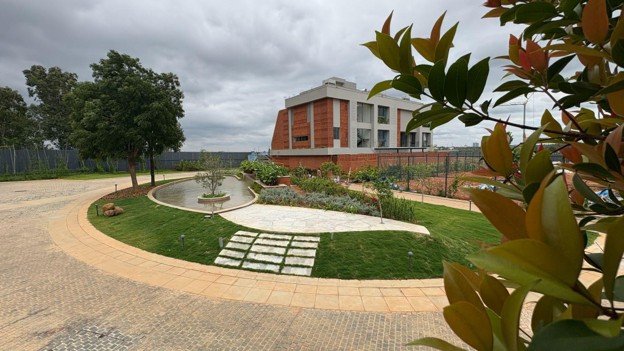
Water features in luxury developments are usually presented purely as visual amenities, but the better-designed examples are doing real environmental work alongside looking attractive. A pond or water channel positioned correctly within a masterplan can measurably lower the surrounding microclimate through evaporative cooling, support groundwater recharge rather than simply displacing rainwater into stormwater drains, and create a habitat corridor that draws birdlife into the community, which itself contributes meaningfully to how alive and settled a landscape feels within just a few years of planting.
The test for whether a water feature is doing this dual job, rather than existing purely for the marketing photograph, is usually straightforward: ask how it is fed, whether it connects to the site’s broader rainwater management strategy, and whether it requires constant fresh water top-up. A water feature dependent on continuous fresh water input is a decorative liability disguised as an amenity, an issue closely tied to the broader questions of water security and climate resilience we have examined in relation to net-zero and climate-resilient villa design.
Source: White Lotus Amanvana
Native and Tropical Species: The Long-Term Maintenance Argument
The financial case for native and regionally appropriate tropical planting is often underappreciated by buyers evaluating a project at launch, when every landscape looks freshly installed and well-tended. Species suited to Bangalore’s climate and rainfall patterns establish faster, require substantially less water and chemical intervention once mature, and are more resilient to the pest pressures that frequently damage imported ornamental varieties. Over a decade, this translates directly into lower community maintenance charges and a landscape that continues to look intentional rather than one that requires constant, visible remediation.
The Private Garden Within a Community Masterplan
For terraced villa formats in particular, private garden design deserves its own scrutiny, separate from the community’s shared green spaces. A well-designed private garden considers orientation carefully, since a south-facing garden behaves very differently from a north-facing one in Bangalore’s climate, along with soil depth sufficient to support real planting rather than a thin layer over hardscape, and enough privacy buffering from neighbouring plots that the garden functions as usable outdoor living space rather than a visual gap between two buildings. Buyers evaluating a villa should look specifically for how much thought has gone into these details at the individual unit level, not just the shared amenity areas that appear in marketing material, a distinction we have unpacked further in our piece on low-density living and wellness-oriented architecture.
How to Read a Landscape Masterplan Like a Buyer
- Ask what proportion of the total site is genuine open, green space rather than paved amenity area or roads
- Ask whether the landscape architect worked alongside the building architects from the masterplanning stage, or was brought in afterward
- Ask what percentage of the species palette is native or climate-appropriate versus imported ornamental
- Ask how irrigation is sourced, drip and rainwater harvesting systems are considerably more sustainable than open sprinklers on borewell water
- Visit a completed phase, if one exists, rather than relying solely on renders, since landscape quality is one of the easiest things to overstate on paper
Amanvana’s Open Space as a Working Example
White Lotus Group’s Amanvana, spread across 14 acres in Devanahalli with 70 percent of the site kept as open space, was designed with landscape treated as a primary variable rather than a finishing touch. The masterplan integrates mature tree retention, climate-appropriate planting and water-sensitive design directly into the layout of the 95 villas, rather than fitting greenery into whatever ground was left over after construction. It is a useful illustration of the broader argument this piece is making: at this scale and price point, green design demands the same rigour, the same technical planning and the same long-term thinking as structural architecture, not a generic greenery specification handed over as an afterthought.
This philosophy runs consistently through how the community has been described from the outset, as a genuine home of sanctuaries rather than a conventional gated layout, a framing that only holds up if the landscape does the quiet, structural work this article has described, not merely the decorative work most developments settle for.
There is a governance dimension to this as well, one that rarely makes it into a marketing conversation but matters enormously to how a landscape actually ages. Who is responsible for pruning, replacement planting and irrigation upkeep once the developer’s initial contract period ends? Communities that transition this responsibility to a professionally managed resident welfare association, backed by a clear long-term maintenance budget, tend to preserve their landscape quality far better than those that leave it to informal, ad hoc arrangements among residents. This is worth asking about directly during due diligence, since a beautiful landscape at launch says very little about who will be accountable for keeping it that way five years on.
The Long View
Landscape architecture rewards patience in a way that building architecture does not. A well-designed structure looks essentially finished on the day of handover. A well-designed landscape looks like a promise on that same day, and only becomes what it was meant to be several years later, once the canopy has closed, the soil has recovered, and the birds have found it. For buyers evaluating a luxury villa community, that patience is worth factoring into the decision. The landscape a resident walks through a decade after possession will say more about how seriously a developer thought about green design than anything in the launch brochure ever could, which is precisely why it deserves to be evaluated with the same rigour as everything else in the home.
Frequently Asked Questions
1. What is the difference between decorative planting and true ecological design in luxury villas in Bangalore?
Decorative planting focuses on non-native, high-maintenance foliage styled for immediate visual impact. In contrast, true ecological landscaping in luxury villas in Bangalore uses climate-appropriate native species, drip irrigation, and rainwater harvesting. This builds a self-sustaining ecosystem that reduces long-term maintenance costs and naturally cools the microclimate.
2. How does mature tree canopy improve livability in gated community villas in North Bangalore?
A mature tree canopy lowers ambient outdoor temperatures by several degrees through shade and evapotranspiration. In premium gated community villas in north bangalore, dense foliage acts as an organic acoustic barrier, absorbing ambient sound and preserving deep quiet across walkways, private gardens, and outdoor decks.
3. How does landscape masterplanning contribute to a home of sanctuaries?
Developments designed around the concept of a home of sanctuaries treat landscape as a core architectural element. By incorporating tree retention, natural water channels, and extensive setbacks into early masterplanning, these communities deliver genuine privacy, cleaner air, and a restorative living environment.
4. What makes Amanvana Bangalore’s open-space plan unique among villa projects?
Amanvana Bangalore reserves 70 percent of its 14-acre site for open green spaces. Built with a Balinese-inspired philosophy, white lotus amanvana integrates native canopy planting, water-sensitive microclimates, and private terraced gardens directly into its layout, setting a high benchmark among the best villa projects in north bangalore.
5. Why should buyers scrutinize landscape architecture when comparing independent luxury villas in Bangalore?
While floor plans look complete on day one, landscape design reveals its true value over time. Thoroughly planned green infrastructure in independent luxury villas in Bangalore fosters privacy, lowers microclimate temperatures, and protects long-term property values through efficient, lower resident association maintenance costs.