How Modern Luxury Homes in Bangalore Are Using Vaastu to Reclaim Ancient Spatial Wisdom
Introduction
There is a moment that many architects working at the intersection of contemporary design and traditional knowledge describe with a similar kind of surprise: the moment they first run the numbers on a Vaastu-aligned floor plan and discover that the spatial prescriptions they might have dismissed as culturally contingent ritual are, in fact, producing measurable outcomes in daylighting, ventilation, and thermal comfort. The north-east orientation of the entrance. The placement of the kitchen in the south-east. The avoidance of structural mass in the north and east quadrants. These are not arbitrary rules. They are the accumulated result of centuries of empirical observation about how buildings perform in the South Asian climate and landscape.
The revival of serious architectural engagement with Vaastu Shastra is one of the more interesting developments shaping luxury homes in Bangalore today. It is not a retreat from modernism. It is, rather, a more intellectually honest engagement with what modernism, at its best, has always claimed to value: evidence, performance, and the rigorous matching of design decisions to environmental and human outcomes.
This piece attempts to explain Vaastu Shastra clearly, separate what is empirically grounded from what is more properly understood as cultural belief, and show why the best luxury residential architecture today is engaging with this tradition not out of deference to client preference but because doing so produces genuinely better buildings. The argument is not that Vaastu is infallible. It is that the tradition contains a core of climate-responsive spatial intelligence that any architect designing in South Asia would be foolish to ignore.
Chapters
- Introduction
- What Vaastu Shastra Actually Is: Beyond the Misconceptions
- The Climate Science Behind Vaastu House Design and Cardinal Orientations
- Spatial Proportions and the Psychology of Living Well
- Bioclimatic Design: The Modern Language for Ancient Principles
- How Gated Community Villas in Bangalore Integrate Vaastu
- The Psychological Dimension: Wellbeing by Design
- Amanvana: Where Vaastu House Design Meets Contemporary Luxury
- Working with a Vaastu Consultant: Practical Guidance for Buyers
- The Market Premium: What Vaastu Compliance Means for Property Value
- Conclusion: The Ancient and the Modern, Better Together
What Vaastu Shastra Actually Is: Beyond the Misconceptions
Vaastu Shastra, which translates roughly as “the science of dwelling,” is a body of ancient Indian knowledge about architecture, urban planning, and spatial organisation that developed over many centuries, with its most systematic formulations appearing in texts dating from approximately the first millennium CE. Like much ancient technical knowledge, it has accumulated layers of interpretation over time – some grounded in the original observational tradition, and some reflecting later cultural accretions that are properly understood as belief rather than empirical practice.
The confusion between these two layers is at the root of the difficulty that educated, rationalist buyers and designers have with Vaastu. When Vaastu is presented as a system of cosmic correspondences – of propitious and inauspicious directions mediated by planetary energies – it is making claims that are not empirically testable and that many people reasonably decline to credit. But beneath and behind this interpretive layer is something quite different: a highly refined system of climate-responsive architecture developed for the specific conditions of the Indian subcontinent.
This core system addresses solar angles, prevailing wind directions, thermal mass, natural ventilation pathways, drainage gradients, and the psychological experience of spatial sequences and proportions. It is empirical, observational, and testable. And when tested, it performs remarkably well. Understanding Vaastu house design in this way liberates it from the false choice between superstitious compliance and rational dismissal.
The textual tradition itself is aware of this distinction. The Manasara, one of the most comprehensive classical Vaastu texts, is primarily a technical treatise on construction, measurement systems, material specification, and spatial proportion. Its concerns are overwhelmingly practical: how do you build a building that stands up, remains comfortable across seasons, and supports the functions it is designed for? The cosmic symbolism that surrounds this technical core is, for the practicing architect, the packaging rather than the product.
The Climate Science Behind Vaastu House Design and Cardinal Orientations
The cardinal orientation system that organises most Vaastu spatial prescriptions is fundamentally a solar and wind science. Understanding why requires a brief orientation to the specific climatic conditions of peninsular India.
The North-East: Light Without Heat
In the northern hemisphere, and specifically at the latitudes that encompass most of India, the sun’s arc across the sky is always in the southern half. North-facing facades receive diffuse, indirect light throughout the day, without the direct solar gain that south and west facades experience during the long summer months. North-east light, received in the morning hours before the sun has climbed to its full intensity, is the softest and most psychologically pleasant natural light of the day.
This is why Vaastu prescriptions consistently locate the most important and frequently used spaces in the north and north-east quadrants: living areas, the main entrance, meditation and prayer spaces. When you enter a house whose main door faces north-east, you are walking into the most gently illuminated and thermally comfortable sector of the building. Approaching from the north-east means walking toward the building with the sun behind you or to your side – the entrance is well-lit, and the transition from exterior glare to softer interior light is gentle and welcoming.
The South-East: The Logic of the Kitchen
The location of the kitchen in the south-east quadrant is perhaps the most widely known and most misunderstood Vaastu prescription. The underlying logic is thermal and ventilation. In South India, the dominant monsoon winds arrive from the south-west. A kitchen located in the south-east receives this cross-ventilation directly: prevailing winds enter the building from the south-west, carry cooking fumes and heat through the kitchen on the south-east side, and exhaust through openings on the north and north-east sides. The result is a kitchen that, under natural ventilation conditions, is cooler and less fume-laden than a kitchen located in a less favourable position.
The fire element association in the tradition is, from this perspective, a poetic encoding of a practical observation: the place where fire is used should be where the natural ventilation system carries its products away most effectively. The metaphysical language is a vessel for technical knowledge, and like many such vessels in traditional technical traditions, it has preserved the knowledge effectively across the centuries.
The South-West: Stability, Mass, and Thermal Buffering
Vaastu prescriptions for the south-west quadrant consistently call for it to be the heaviest, most massive, and highest part of a building. The south-west elevation of a building in India receives the most intense afternoon and early evening sun – precisely the hottest and most uncomfortable solar exposure of the day. Placing the most thermally massive elements of the building in the south-west quadrant creates a thermal buffer that absorbs solar gain and slows its transmission into the interior.
The prescription to place the master bedroom in the south-west has a specific rationale worth unpacking. The south-west room in a thermally well-designed building warms slowly through the day as the massive walls absorb solar gain, reaches peak temperature in the early evening, and releases stored heat slowly through the night. This makes it the warmest room in the house during evening hours – precisely when a bedroom is occupied. For the experience of sleeping in a warm climate, a room that maintains stable temperature through the night is significantly preferable to one that cools rapidly.
Spatial Proportions and the Psychology of Living Well
Beyond the solar and climatic logic of Vaastu’s cardinal orientations, there is a second dimension of the tradition that is receiving renewed attention from contemporary designers: its system of spatial proportions and sequential spatial experience. Vaastu texts devote considerable attention to the proportional relationships between spaces – the ratios of width to length in rooms, the relationships between ceiling height and floor area, the sequencing of spaces from public to private, and the management of visual and physical transitions between different zones of a building.
Modern environmental psychology has independently arrived at many of the same conclusions. Research on the psychological experience of architectural space consistently shows that people are most comfortable and most productive in rooms whose proportions fall within certain ranges, and that spatial sequences managing the transition between public and private zones in a graduated rather than abrupt way produce better psychological comfort outcomes.
The Vaastu concept of the Brahmasthan – the central space of a building that should be left open or minimally enclosed – corresponds closely to what contemporary architecture knows as the courtyard or atrium principle: a central open or semi-open space that regulates air movement, distributes light, and provides a psychological anchor around which the rest of the building is organised. This design feature appears in high-performance buildings across virtually every climatic zone, implemented through entirely different intellectual traditions but converging on similar geometric solutions.
Source: White Lotus Amanvana
Bioclimatic Design: The Modern Language for Ancient Principles
The contemporary architectural tradition that most closely corresponds to what Vaastu Shastra has always been doing is bioclimatic design: the practice of designing buildings that respond specifically to the local climate in a way that minimises mechanical intervention and maximises natural environmental performance. When a bioclimatic architect designs for the specific conditions of the Deccan Plateau, they arrive at spatial prescriptions that are strikingly similar to those of Vaastu Shastra: east and north-east orientations for primary living spaces, south-west thermal mass, cross-ventilation pathways aligned with prevailing seasonal winds, deep overhangs to control solar gain, central open spaces to drive thermal convection.
These convergences are not coincidental. They reflect the fact that both traditions are responding to the same physical realities with similar observational rigour. The difference is that bioclimatic design arrives at these prescriptions through explicit quantitative analysis – sun path diagrams, CFD modelling of air movement, energy simulation software. Vaastu Shastra arrived at them through centuries of empirical observation, encoded in a tradition transmitted through a language of cosmic correspondence and ritual prescription. The methodology differs; the outcomes often do not.
The energy savings that result from a properly Vaastu-aligned, bioclimatically designed building in Bangalore’s climate are not trivial. Reductions in air conditioning energy use of 30 to 50 percent compared to conventionally designed buildings of equivalent size are achievable when passive design strategies are implemented well. For a luxury home owner who will live in the property for decades, this represents a significant financial saving over the holding period, quite apart from the environmental benefit.
How Gated Community Villas in Bangalore Integrate Vaastu
For the contemporary luxury developer and their architectural team, the practical question is how to integrate Vaastu principles in a way that is authentic, effective, and intellectually honest – neither dismissing the tradition as superstition nor applying it dogmatically in ways that compromise modern design intentions. The best current practice treats Vaastu as a primary input into the site orientation and floor plan development process, evaluated alongside other inputs such as views, access, privacy, and programmatic requirements.
This integrated approach is particularly well-suited to gated community villas in Bangalore, where the site master plan is being developed from scratch and Vaastu principles can be embedded directly into the layout without compromising any other design objectives. North-east entry points for the community and individual plots, the positioning of water features and landscape elements in the north and east, the concentration of built mass and service infrastructure in the south and west – these are all site planning decisions that can be taken in alignment with both Vaastu principles and contemporary planning best practice simultaneously.
Orientation and Plot Layout
At the site planning stage, Vaastu principles provide clear guidance on how plots and buildings should be oriented relative to the cardinal directions. The orientation of the access road, the placement of the community entrance gate, the positioning of common amenity areas – all of these site-level decisions have their Vaastu correlates, and all of them have practical consequences for the experience of the development that extend beyond any individual residence. A Vaastu-considered site master plan produces a development whose spatial logic is coherent from the moment of arrival to the interior of each home.
Floor Plan Development in 4BHK Villas
At the building scale, the floor plan is where Vaastu principles have the most direct impact. The placement of the entrance, the orientation of the primary living spaces, the location of the kitchen, master bedroom, and study, the management of the central space – all of these are floor plan decisions that Vaastu addresses explicitly.
Contemporary 4BHK villas in Bangalore with generous floor plates and high ceiling heights offer the spatial freedom to honour Vaastu principles without the compromises that constrained apartment floor plans often require. The spatial generosity that distinguishes a luxury villa from a premium apartment is precisely what makes Vaastu-aligned design most achievable. When you have enough space to do things properly, you do not have to choose between good orientation and good function – you can have both.
This is one of the less-discussed advantages of the luxury villa format that architects at the higher end genuinely appreciate. The spatial budget allows them to resolve design problems in ways that genuinely optimise across multiple criteria simultaneously, including the environmental performance criteria that Vaastu encodes. The resulting buildings are not merely Vaastu-compliant in a box-ticking sense. They are physically, measurably better buildings.
Material Selection and Thermal Mass
Vaastu’s attention to the south-west as the location for structural heaviness and mass translates, in contemporary practice, into specific decisions about wall construction and material specification on the south-western elevations. Natural stone, dense masonry, and earth-stabilised building materials in these positions create the thermal buffer that both traditions recommend for the same physical reason.
Contemporary luxury finishes and natural materials – stone, hardwood, wire-cut bricks, terracotta, compressed earth tend to align naturally with Vaastu’s material preferences for reasons that go beyond tradition: they are also the materials with the best thermal performance characteristics and the most authentic connection to the architectural heritage of South India. Good design, good sustainability, and good Vaastu tend to converge on the same material choices, which is itself evidence that the tradition is tracking something real rather than arbitrary.
The Psychological Dimension: Wellbeing by Design
There is a dimension of the contemporary interest in Vaastu best understood through the lens of environmental psychology rather than architecture. Research on the relationship between built environment and human wellbeing has accelerated significantly in the last decade, and the findings consistently reinforce intuitions that Vaastu has always expressed: that the quality of light, the proportions of space, the acoustic properties of a room, and the sequencing of spatial experience have measurable effects on cognitive function, emotional state, stress levels, and overall health outcomes.
A growing body of research specifically examines the effect of natural light quality on human health and cognitive performance. Morning light – particularly the blue-spectrum light that predominates in north-east orientation during the early hours – is a primary regulator of the human circadian rhythm. Buildings that give their occupants generous access to morning natural light in the primary living and working spaces are not merely aesthetically pleasant. They are physiologically beneficial: supporting better sleep, more stable mood, and sharper cognitive function through the mechanism of circadian entrainment.
Vaastu’s consistent prescription of north-east orientation for primary living and entrance spaces predates the science of circadian biology by many centuries, but it produces the same outcome: buildings whose occupants receive optimal exposure to morning natural light. The tradition arrived at the right answer through empirical observation of how people felt and performed in differently oriented buildings. Modern science has provided the mechanistic explanation for why that answer is right.
The buyer who specifies Vaastu compliance in their luxury homes in Bangalore is not simply fulfilling a cultural obligation or managing superstitious anxiety. In many cases, they are making an intuitive demand for a certain quality of spatial experience that they have come to associate with Vaastu-aligned buildings. They know, from experience, that well-oriented, proportionally considered spaces with good natural light and cross-ventilation feel different – more comfortable, more energised, more mentally clear. This intuitive response is a direct perception of the physical qualities that Vaastu principles, implemented well, reliably produce.
Amanvana: Where Vaastu House Design Meets Contemporary Luxury
The integration of Vaastu principles into a luxury residential development like Amanvana represents an approach that takes the tradition seriously as a design resource rather than treating it as a mandatory disclosure. The terraced villa format – with its generous floor plates, high ceilings, and natural landscape setting – is particularly well-suited to the full expression of Vaastu principles.
The spatial programme of a premium villa, across two or three levels, allows the public-private sequence, the orientation of each functional space to its optimal cardinal quadrant, and the management of the central Brahmasthan to be handled with a degree of spatial intelligence that smaller formats simply cannot accommodate. This is Vaastu house design at its most complete expression – not a checklist of compliances but a coherent spatial logic that runs from the community entrance to the interior of each bedroom.
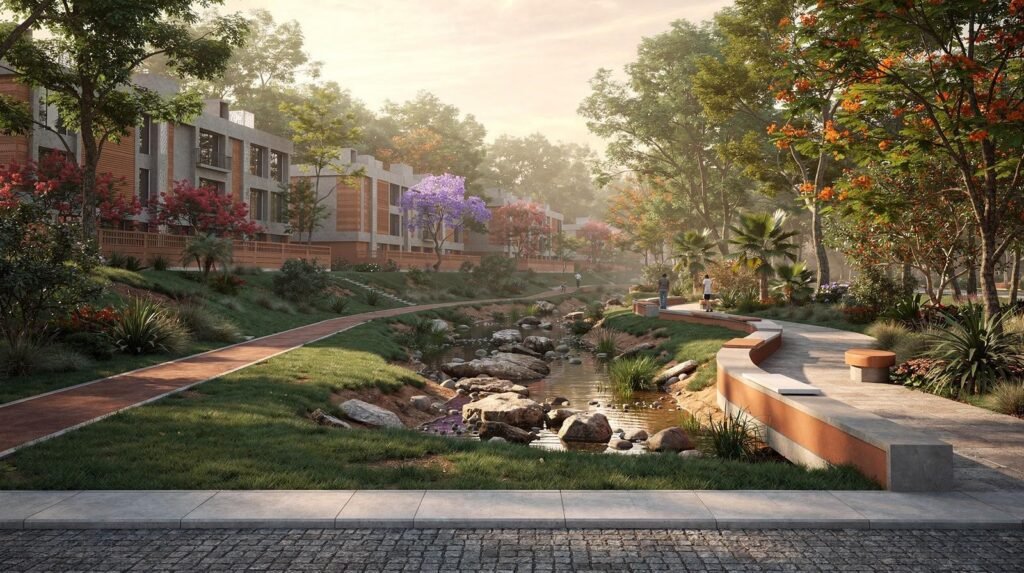
The landscape design in a Vaastu-considered development also takes on a different character. The north and east of the site, which Vaastu prescribes should be kept open and light, become the primary garden and landscape areas – open, well-lit, and visually generous. The south and west accommodate the service infrastructure, boundary walls, and structural landscaping. The result is a landscape that flows naturally from the built form rather than being imposed upon it.
Working with a Vaastu Consultant: Practical Guidance for Buyers
For buyers who are serious about Vaastu alignment in their residential investment, a few practical considerations deserve attention. The most important is the distinction between a genuine Vaastu practitioner with architectural training and a consultant whose practice is primarily ritualistic. A credible Vaastu architect should be able to explain the physical rationale behind their prescriptions in terms that make sense – connecting recommendations to solar angles, ventilation pathways, thermal mass, and spatial proportion. If the explanation is primarily in terms of energy or ritual prescriptions without any physical grounding, the practice is more properly understood as folk belief than as applied spatial science.
The second consideration is the sequence in which Vaastu is engaged. The most effective integration of Vaastu principles happens at the earliest design stages, when plot selection, orientation, and basic floor plan organisation are still open questions. Engaging a Vaastu consultant after the floor plan is fixed and asking them to certify the completed design is a largely cosmetic exercise. The genuine benefits come from building the spatial logic into the foundation of the design, not from applying it to a completed scheme.
The third consideration is the management of trade-offs. In practice, Vaastu prescriptions sometimes conflict with other design priorities: the view is to the south-west rather than the north-east, the access road approaches from the west rather than the east. A good Vaastu architect will help navigate these trade-offs intelligently, prioritising the most physically significant prescriptions – typically those related to solar orientation and natural ventilation – over those that are more symbolically important.
The Market Premium: What Vaastu Compliance Means for Property Value
Beyond its functional and experiential benefits, Vaastu alignment in a luxury residential property has a documented market dimension. Research on buyer preferences in the Indian luxury residential market consistently shows that Vaastu compliance is among the most frequently cited purchase criteria, particularly in the premium segment. This is especially visible in the market for gated community villas in Bangalore, where competing developments increasingly position their Vaastu credentials as a primary point of differentiation.
The market premium for Vaastu-compliant properties is real and measurable. Resale transactions on properties with documented Vaastu alignment by a credible practitioner consistently achieve better prices and shorter time-on-market than comparable properties without this credential. The mechanism is partly functional – the alignment genuinely does produce better physical performance – and partly signalling: Vaastu compliance communicates that the developer took the property seriously, invested in its design quality, and respected the values of its target buyers.
For a luxury developer, the calculus is relatively straightforward. Engaging seriously with Vaastu design at the planning stage adds modest cost and complexity to the design process but delivers meaningful benefits in both the physical performance of the building and its market positioning. In the competitive segment of 4BHK villas in Bangalore, where buyers are comparing multiple premium offerings, this differentiation is increasingly visible and increasingly valued.
Conclusion: The Ancient and the Modern, Better Together
The engagement of contemporary luxury architecture with Vaastu Shastra is not a retreat from modernity or a concession to superstition. It is an expression of intellectual maturity: the recognition that a design tradition refined over many centuries in a specific climate and cultural context contains wisdom worth taking seriously, even if its original vocabulary is unfamiliar to those trained in the Western architectural canon.
The buildings that emerge from a serious integration of Vaastu spatial intelligence with contemporary design, materials, and technology are not merely different. They are better: more comfortable, more energy-efficient, more aligned with the physical rhythms of their climate, and more resonant with the cultural intuitions of the people who live in them. The measurable outcomes – in daylighting quality, thermal performance, natural ventilation, and acoustic comfort – justify the engagement on purely functional grounds.
For families and investors evaluating luxury homes in Bangalore, the question of Vaastu alignment is worth asking not as a superstitious concern but as a design quality question. The answer tells you whether the architect and developer have engaged seriously with the environmental and experiential performance of the building, or whether they have treated it as a sales credential rather than a design commitment. The difference, in the quality of the home you end up with, is significant and lasting.
To explore how Vaastu principles are integrated into the design of a contemporary luxury villa in North Bangalore, visit Amanvana by White Lotus Group.
Frequently Asked Questions
- What is Vaastu house design and how does it apply to modern homes?
Vaastu house design is an ancient Indian architectural system that uses solar orientation, wind direction, and spatial proportions to create buildings that are naturally comfortable and energy-efficient. In modern homes, these principles are applied through room placement, entrance orientation, and material selection rather than purely ritual compliance.
- Do luxury homes in Bangalore really follow Vaastu principles?
Yes, increasingly so. Premium developers are integrating Vaastu at the design stage – not as a checklist but as a spatial planning tool that improves natural light, cross-ventilation, and thermal comfort. The result is homes that perform measurably better and command stronger resale value.
- What is the ideal Vaastu orientation for a home in Bangalore?
The north-east is considered the most favourable orientation for the main entrance, as it receives the softest morning light and the most comfortable natural illumination. The kitchen is best placed in the south-east for ventilation, and the master bedroom in the south-west for thermal stability through the night.
- Are gated community villas in Bangalore designed with Vaastu in mind?
The best ones are. Premium gated communities integrate Vaastu at the site master plan level – positioning entry gates, water features, landscaping, and plot orientations in alignment with Vaastu principles before individual floor plans are even drawn. This community-level Vaastu planning produces a more coherent and better-performing development overall.
- Does Vaastu compliance affect the resale value of 4BHK villas in Bangalore?
Yes, noticeably. Vaastu-compliant properties in the luxury segment consistently achieve better resale prices and sell faster than comparable non-compliant properties. For 4BHK villas in Bangalore, where buyers are making significant investments, Vaastu alignment is increasingly a non-negotiable criterion that directly influences purchase decisions.