Architectural Therapy: How Low-Density Living Heals the Urban Soul
Architectural Therapy: How Low-Density Living Heals the Urban Soul
There is a reason why the most restorative moments of a city dweller’s life rarely happen in the city. A long weekend at a hill station, a morning at the edge of a reservoir, an afternoon in a garden that is not shared with a hundred other families: these are the moments when something in the body unclenches, when the background hum of vigilance that accumulates through days of urban living finally subsides.
For most, these are brief escapes from the default conditions of urban fatigue architecture, a return to density and noise that is simply the price of modern life. But what if the architecture of your everyday home was designed to produce the same quality of ease that you usually have to travel to find? This is the central insight of low-density living wellness architecture. Among luxury villas in Bangalore, only a handful are genuinely built around this principle.
But what if those conditions were not the default? What if the architecture of your everyday home was designed not to maximise occupancy or sellable square footage, but to produce the same quality of ease that you usually have to travel to find? For those evaluating villas in North Bangalore, this question is increasingly shaping where they choose to buy.
This is the central insight of low-density residential design. And it is backed by a growing body of research in environmental psychology, neuroscience, and public health that is beginning to reframe how we think about what a home is for.
Chapters
- Introduction: Architectural Therapy
- What Environmental Psychology Tells Us About Urban Density
- Directed Attention Fatigue
- Visual Noise and Its Cognitive Cost
- The Restorative Environment
- The Specifics: What Low-Density Design Actually Means
- Homes Per Acre: Why the Number Matters
- The Inward-Facing Garden
- Acoustic Design and the Sound of Quiet
- Natural Light as Health Infrastructure
- Privacy, Social Density, and the Nervous System
- The Healing Garden: A Brief History and a Contemporary Case
- Vaastu and Environmental Psychology: Two Traditions, One Logic
- What This Means for How We Choose Homes
- Amanvana: Low-Density Design as a Lived Philosophy
- Beyond Amenities: Rethinking What a Luxury Home Is For
- Conclusion: The Architecture of Wellbeing
What Environmental Psychology Tells Us About Urban Density
Environmental psychology housing research – the study of how physical settings affect human thought and emotion – consistently finds that density is stressful. The mechanisms of this stress are nuanced, particularly regarding Directed Attention Fatigue. Urban environments demand constant “directed attention,” a depletable resource. Sustained use leads to irritability and reduced empathy.
The core finding is not surprising when you state it directly: density is stressful. But the mechanisms by which density produces stress, and the specific design interventions that can mitigate or reverse those effects, are more nuanced and more actionable than the simple statement suggests.
Directed Attention Fatigue
One of the most influential frameworks in environmental psychology is Attention Restoration Theory, developed by environmental psychologists Rachel and Stephen Kaplan. Their research proposed that human attention operates in two distinct modes: directed attention, the effortful focus we deploy to navigate complex tasks, social situations, and information-rich environments, and involuntary attention, the effortless fascination that is engaged by natural environments, water, trees, open sky, and the patterns of the natural world.
Directed attention, unlike involuntary attention, is a depletable resource. Sustained use without adequate recovery leads to a state the Kaplans called directed attention fatigue: impaired concentration, irritability, reduced empathy, and a diminished capacity for complex decision-making. This is not a metaphor. It is a measurable cognitive state with documented neurological correlates.
Urban environments, with their constant demands for navigation, social monitoring, noise management, and information processing, are among the most reliable producers of directed attention fatigue. The high-density residential environment is, in this sense, not merely a reflection of urban conditions but an active contributor to them. When you live in a building shared by hundreds of other households, the demands on your directed attention do not cease when you come home.
Visual Noise and Its Cognitive Cost
Visual noise is a term from perceptual psychology that refers to the cognitive load imposed by complex, dense, and unpredictable visual environments. A high-density apartment complex, with its layered facades, multiple balconies, car parks, service areas, and the visible evidence of hundreds of other lives being lived in close proximity, generates significant visual noise.
Research on visual complexity and stress has consistently found that environments high in visual noise produce elevated cortisol levels, higher reported stress, and reduced capacity for relaxed attentional states. Conversely, environments characterised by natural elements, spatial simplicity, and visual depth – precisely the qualities of a well-designed low-density landscape have been shown to reduce cortisol, lower heart rate and blood pressure, and improve reported wellbeing. This is why discerning buyers looking at luxury villas in Bangalore are increasingly prioritising visual calm and green outlook over floor area or listed amenities.
The visual design of a residential community, its density of built form, the proportion of green space to hard surface, the distance between buildings, and the presence or absence of views to natural features, is not an aesthetic choice alone. It is a health intervention.
The Restorative Environment
Attention Restoration Theory identifies four qualities that make an environment restorative: being away, extent, fascination, and compatibility. Being away refers to a sense of distance from one’s usual concerns and demands, a quality that requires physical or at least perceptual separation from the environments associated with work and obligation. Extent refers to the richness and coherence of the environment as a whole, the sense that it constitutes a complete world rather than a fragmentary backdrop. Fascination refers to the engagement of involuntary attention, which natural environments produce reliably. And compatibility refers to the alignment between what the environment offers and what the individual needs.
A high-density apartment development might score poorly on all dimensions. It is not away from the conditions of urban life; it is, architecturally, an intensification of them. It lacks extent; its visual environment is fragmented by the evidence of other residents and the mechanical systems of a large building. It provides little genuine fascination in the natural sense. And its compatibility with the needs of residents who are carrying high cognitive and emotional loads from urban professional life is structurally limited.
A low-density villa community with private gardens, natural landscaping, and views to open sky scores well on all four. It is, in the language of the research, genuinely restorative. Not because of its price point, but because of its design.
The Specifics: What Low-Density Design Actually Means
The phrase ‘low-density living’ is widely used in real estate marketing, but its meaning varies enormously. Understanding what genuine low-density design entails, and why it matters for the quality of life it produces, requires getting specific.
Homes Per Acre: Why the Number Matters
The most concrete measure of residential density is the number of dwellings per acre of land. In a typical high-rise apartment complex in urban Bangalore, density can reach 80 to 150 units per acre when calculated against the total footprint of the project. Even in projects marketed as ‘luxury,’ the combination of multiple towers on a shared site often results in effective densities that preclude the spatial qualities that support wellbeing.
To understand what buyers seeking 4 BHK villas in Bangalore actually benefit from, we must look at the mathematics of space. At 7 homes per acre, each home commands approximately 6,000 square feet of land. This provides the kind of visual distance from neighboring structures that allows the mind to register quiet rather than activity.
This number is not arbitrary. It reflects, in built form, the kind of spatial density that human psychology is calibrated to find comfortable. There is substantial anthropological and psychological evidence that the human nervous system is most at ease in environments where the density of human activity falls within a range compatible with our social cognition, not so sparse as to feel isolating, not so dense as to require the continuous low-grade vigilance that crowded environments demand.
The Inward-Facing Garden
One of the most psychologically significant design elements of a well-conceived villa community is the inward-facing garden: a private outdoor space that is bounded and sheltered rather than exposed, with views to planting rather than to the street or neighbouring buildings.
The psychology of this design choice draws on research in environmental preference, which has consistently found that humans prefer enclosed, sheltered views with visual depth and natural content over exposed, open, or view-obstructed settings. The evolutionary explanation is that our ancestors were most vulnerable in exposed open spaces, and most safe in locations with good prospect (the ability to see approaching threats) and good refuge (the ability to shelter from them). An inward-facing garden with layered planting, views to soft landscape, and a sense of enclosure satisfies both needs simultaneously.
More practically, the inward-facing garden provides the resident with an outdoor space that is genuinely usable: a place to sit quietly, to garden, to allow children to play, or simply to be in the presence of growing things and open sky without the social performance demands of a shared common area. The difference between a private garden and a shared amenity garden is not merely one of scale. It is a difference in the quality of the psychological space it offers.
Acoustic Design and the Sound of Quiet
One of the most underappreciated dimensions of residential design is acoustic quality. Research in architectural acoustics has established strong links between residential noise levels and a range of health outcomes: sleep quality, cardiovascular health, cognitive performance, and reported life satisfaction are all negatively affected by sustained noise exposure.
In high-density complexes, noise is structural. In contrast, the privacy mental health homes India’s elite are now seeking is built on acoustic calm. Natural soundscapes – wind, birdsong, and rain – activate the parasympathetic nervous system, promoting the rest-and-restoration state that the body needs.
In a low-density villa community with private gardens and meaningful separation between homes, the acoustic environment is fundamentally different. The dominant sounds are natural: wind, birdsong, rain, the movement of water in a garden feature. These are not merely aesthetically pleasant. They are physiologically calming. Natural soundscapes, in contrast to urban noise, have been shown to activate the parasympathetic nervous system, promoting the rest-and-restoration state that the body needs to recover from the demands of contemporary professional life.
Natural Light as Health Infrastructure
The relationship between natural light and human health is one of the most thoroughly documented in the built environment literature. Circadian rhythm, the internal biological clock that governs sleep, hormone regulation, mood, and immune function, is primarily calibrated by exposure to natural light. Insufficient natural light, or light arriving at the wrong times or in insufficient quantities, disrupts this calibration with measurable consequences for health.
High-density apartment living is, by its nature, often associated with compromised natural light. Lower floors of tall buildings may be significantly shaded by neighbouring structures. Apartments facing internal light wells may receive limited direct sunlight. Even well-positioned high-floor apartments, while they may enjoy good views, often have window configurations optimised for views rather than for light penetration at floor level where residents actually spend their time.
A villa with a thoughtfully oriented garden receives natural light across its primary living surfaces throughout the day. The layout can be designed to admit morning light to bedrooms, midday light to common areas, and evening light to outdoor spaces. This is not a luxury feature. It is a basic element of health-supporting residential design.
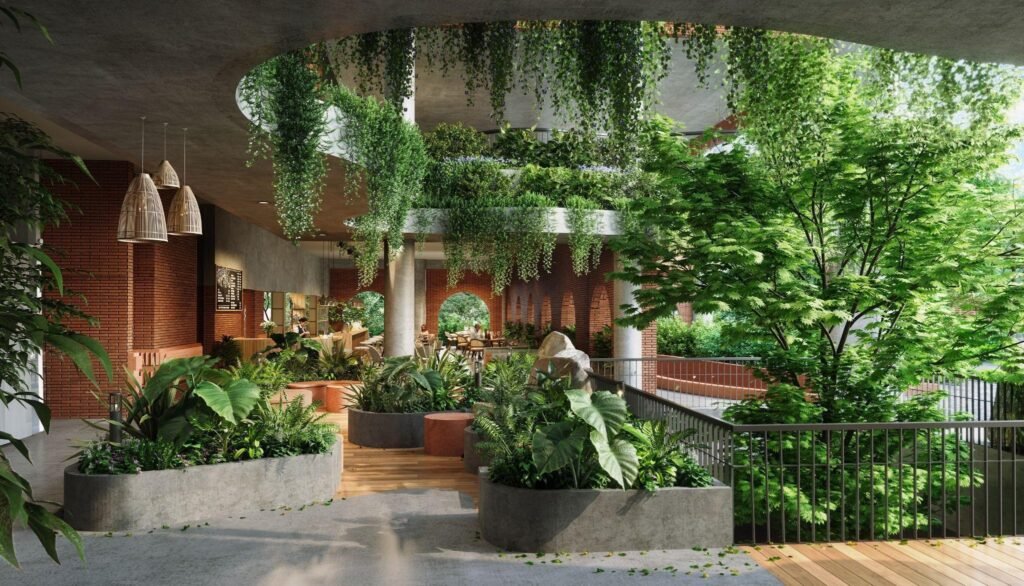
Source:White Lotus Amanvana
Privacy, Social Density, and the Nervous System
Human beings are intensely social animals, but we are also animals with a profound need for privacy. These two needs are not in conflict. The problem with high-density living is not that it offers too much community – it is that it offers too little choice. The social exposure it creates is involuntary, continuous, and structurally unavoidable. That is a very different thing from the warmth of a community you have actively chosen to be part of.
Research on social density and stress consistently shows that conditions of involuntary social exposure – being surrounded by others when you have not chosen to be – produce elevated physiological stress markers: higher cortisol, higher sympathetic nervous system activation, and lower reported psychological wellbeing. This effect is strongest in domestic environments, where the expectation of privacy is greatest and the contrast between expectation and reality is most acutely felt. The shared corridors, communal car parks, and thin walls of a high-density apartment complex create a background condition of low-grade alertness that does not switch off when you come home.
Low-density villa communities resolve this not by eliminating community but by making it voluntary. When your private garden is genuinely private and your home is spatially separated from your neighbours, your awareness of those neighbours becomes a matter of choice rather than imposition. You can open the gate and share an evening with the family next door – or you can close it and be entirely, restoratively alone. Both are available. Neither is forced.
This is the social quality that a well-designed villa community of seven or eight homes per acre actually produces: not isolation, but the conditions for genuine connection. Smaller communities tend toward familiarity rather than anonymity. Residents know each other by choice and by name, not by the accident of sharing a lift lobby. The social fabric of such a community is quieter than that of a large apartment complex, but it is also more real – built on interaction that both parties have freely elected, which is the only kind that restores rather than depletes.
The Healing Garden: A Brief History and a Contemporary Case
Bangalore was, not very long ago, a city defined by its gardens. The colonial-era bungalows of Basavanagudi, Malleswaram, and Richmond Town sat within generous planted compounds – rain trees casting shade over laterite walls, jasmine climbing verandas, the evening air carrying the scent of parijata. The city earned its reputation as a garden city not through civic planning alone but through a residential culture that understood the garden as integral to the home, not an addition to it.
That Bangalore is largely gone now, absorbed into the density of a rapidly expanding tech metropolis. But the need it answered, has not gone anywhere. The desire to step outside into something green and quiet, to sit under a tree that belongs to you rather than to a housing society, to hear birdsong before the traffic begins – these are not nostalgic preferences. They are genuine psychological needs, and the research increasingly confirms what Bangaloreans who grew up in those older neighbourhoods have always known intuitively.
Modern research has given this intuition a rigorous foundation. Studies of stress recovery have found that even brief exposure to natural settings produces significant reductions in cortisol and sympathetic nervous system activity. The effect is most powerful when the natural exposure involves vegetation, open sky, and the sensory complexity of living rather than built environments.
The private garden of a low-density villa is, in this context, not an amenity. It is a restoration of something the city once offered as standard. It is telling that the most considered attempts to recover this quality of living are happening in villas in North Bangalore – where land, landscape, and a degree of distance from the urban core make it genuinely achievable again.
Vaastu and Environmental Psychology: Two Traditions, One Logic
The principles of Vaastu Shastra, the ancient Indian system of spatial design, occupy an interesting position in relation to contemporary environmental psychology. The two traditions developed independently, in very different historical and cultural contexts, and their explanatory frameworks are entirely different. But when you examine what each tradition recommends, the overlaps are striking.
Vaastu Shastra and low-density living wellness architecture develop from different contexts but arrive at similar conclusions. Vaastu’s preference for north and east-facing orientations aligns with clinical findings on the benefits of specific natural light patterns. The Vaastu emphasis on “flow” and thresholds reflects a deep understanding of territorial cognition and psychological comfort.
The Vaastu emphasis on flow, on the smooth, unobstructed movement of both physical movement and air through a space, reflects insights about spatial cognition and perceptual comfort that contemporary architecture is only now beginning to formalise. And the Vaastu concern with thresholds, with how the home transitions from outside to inside, from public to private, reflects a deep understanding of the psychological significance of these transitions that is confirmed by research on territorial cognition.
This convergence suggests that Vaastu, properly understood, is not a system of rules to be complied with but a body of accumulated spatial intelligence. When contemporary luxury villa design incorporates Vaastu principles thoughtfully, it is drawing on a tradition that has been observing the relationship between space and human experience for millennia.
What This Means for How We Choose Homes
The research and principles outlined in this article have a practical implication for anyone evaluating a luxury residential purchase: the qualities that make a home genuinely restorative are not the same as the qualities that make a home look impressive in marketing materials.
A home can photograph beautifully and be a challenging environment to actually live in. Grand lobbies, impressive facades, and extensive listed amenities are not reliable indicators of the day-to-day quality of life a home will provide. The things that actually matter to wellbeing, density, acoustic quality, natural light, access to private outdoor space, and genuine privacy, are often invisible in a show flat and absent from a brochure.
For anyone actively browsing villas for sale in Bangalore, the questions worth asking are not primarily about specifications or finish levels, though these matter. They are about how the home feels at different times of day. How much natural light reaches the primary living spaces in the morning, at noon, in the late afternoon? What can you hear from inside the home? What do you see from the primary living areas? Is the outdoor space genuinely private? How close are the neighbouring homes, and how visible are they?
These are the questions that environmental psychology has identified as the relevant predictors of residential satisfaction over time. They are worth taking seriously.
Amanvana: Low-Density Design as a Lived Philosophy
Among the luxury residential projects currently available in North Bangalore, White Lotus Amanvana represents a considered attempt to translate the principles of this article into built form. The project’s density of approximately 7 homes per acre is not a marketing claim. It is a structural commitment, built into the site plan, to the kind of spatial quality that genuine low-density living requires.
Each villa at Amanvana has a private landscaped garden: not a shared green space, not a token planted area, but a garden that belongs to the home and is designed to be used. The site’s setting on IVC Road in Devanahalli provides the kind of natural context, open sky, relatively clean air, and visual connection to a landscape that is not entirely built, that makes the restorative qualities of the community coherent rather than cosmetic.
The architectural approach takes Vaastu-compliant orientation seriously, not as a checkbox but as a genuine design principle that shapes how the homes are positioned, how light moves through them, and how the transition from the natural environment of the garden to the interior of the home is handled. The result is a set of homes that, by the measures environmental psychology identifies as meaningful, should feel genuinely good to live in.
For buyers who are beginning to think seriously about what low-density living could mean for their daily quality of life, White Lotus Amanvana offers both a physical reference point and a practical opportunity to experience what these design principles feel like when they are applied with genuine commitment.
Beyond Amenities: Rethinking What a Luxury Home Is For
The dominant marketing language of luxury residential real estate over the past decade has been organised around amenities. The number of swimming pools, the presence of a co-working space, the quality of the gym, the rating of the concierge service: these have been the competitive differentiators, and they have driven a great deal of product development.
There is nothing wrong with amenities. The question is not whether they exist but how they are conceived – and for whom. In a high-density complex of several hundred families, a clubhouse and gym are crowd-management tools as much as lifestyle features. They are designed to serve a large, anonymous population, and they function accordingly: busy, scheduled, and shared with people you may never know by name.
In a low-density villa community of thirty or forty homes, the same amenities operate entirely differently. A shared pool used by a small, familiar community becomes an extension of private outdoor life rather than a public facility. A common garden maintained to the same standard as the private ones becomes a genuine gathering space rather than a visual backdrop. Amenities at this scale are not compensating for the absence of private space – they are complementing it. They give residents a reason to step outside their own gardens and into a shared world, on their own terms and at their own pace.
This is the distinction that matters. Amenities designed in proportion to the community they serve, and conceived as extensions of the residential experience rather than as listed features, add genuine value. What they cannot do – and what no amenity can do – is substitute for the structural qualities that determine how a home actually feels to live in day after day: density, acoustic calm, natural light, and private outdoor space. These are the foundation. Well-considered amenities, at the right scale, are a worthwhile addition to it.
Conclusion: The Architecture of Wellbeing
The proposition of this article is a simple one. The design of the environment we live in is not a neutral backdrop to our lives. It actively shapes our cognitive states, our emotional regulation, our physiological stress levels, and our capacity for restoration and renewal. These are not subtle effects. They compound over years and decades into outcomes that matter profoundly for quality of life.
Low-density residential design, with its emphasis on spatial generosity, private natural space, acoustic calm, and genuine privacy, is not a lifestyle preference for those who can afford it. It is an architectural response to real psychological needs that the high-density residential model, despite its other virtues, cannot adequately address.
For the growing number of buyers who have arrived at this understanding, whether through lived experience, through research, or through the simple recognition that the environments that make them feel best are consistently the quieter, greener, more spacious ones, the choice of home is becoming a deliberate investment in their own wellbeing.
That is a different way of thinking about luxury. And it is, arguably, a more accurate one.
Frequently Asked Questions
- How does low-density living wellness architecture improve daily mental health?
Low-density living wellness architecture focuses on reducing “visual and acoustic noise.” By limiting the number of homes to a human scale (like the 7 homes per acre at White Lotus Amanvana), the design reduces involuntary social exposure and crowding. This lower density allows the nervous system to switch from a state of high-alert urban vigilance to a restorative “parasympathetic” state, effectively healing urban fatigue architecture through space and silence.
- What is the role of environmental psychology housing in modern villa design?
Environmental psychology housing is the study of how our surroundings influence our cognitive load. Modern luxury designs now use these principles to create “restorative environments.” Features like inward-facing gardens, high ceilings for air volume, and strategic window placement for natural light are not just aesthetic choices – they are scientifically proven to lower cortisol levels and improve long-term emotional regulation.
- Why is “acoustic calm” considered a core feature of luxury villas wellness Bangalore?
In high-density apartments, noise is structural and unavoidable. In luxury villas wellness Bangalore buyers are now targeting, acoustic calm is achieved through physical separation and natural barriers. Thick vegetation and land buffers replace shared walls, allowing natural soundscapes – like wind and birdsong – to dominate. These sounds are known in environmental psychology to assist in “attention restoration,” helping the brain recover from the demands of professional life.
- How does White Lotus Amanvana implement privacy mental health homes India’s elite expect?
White Lotus Amanvana implements privacy mental health homes India’s elite demand by creating a “resident-first” master plan where villas are staggered in micro-clusters. Each 4 BHK villa at Amanvana is oriented to protect the resident’s “refuge,” ensuring that private gardens and living spaces are never overlooked by neighbours. This ensures that while you are part of a community, your visual and social interactions are voluntary.
- Is a low-density project on IVC Road a good long-term investment for wellness?
Yes. For those comparing villas for sale in Bangalore purely on price per square foot, this project may initially appear premium. But beyond the immediate health benefits, low-density living wellness architecture holds high long-term value because land is a finite resource. Projects like Amanvana offer a high Undivided Share of Land (UDS) – approximately 5,000 sq. ft. per villa. As Bangalore continues to densify, the rarity of quiet, green, and spacious environments makes these “wellness sanctuaries” some of the most resilient assets in the real estate market.
Instagram | LinkedIn | Whatsapp